Are There Gators In Cocoa Beach?
Alligators can appear in the fresh and brackish waters around Cocoa Beach, but the Atlantic surf is not their habitat. Here is where they actually live, how tours handle them, and how close is too close.
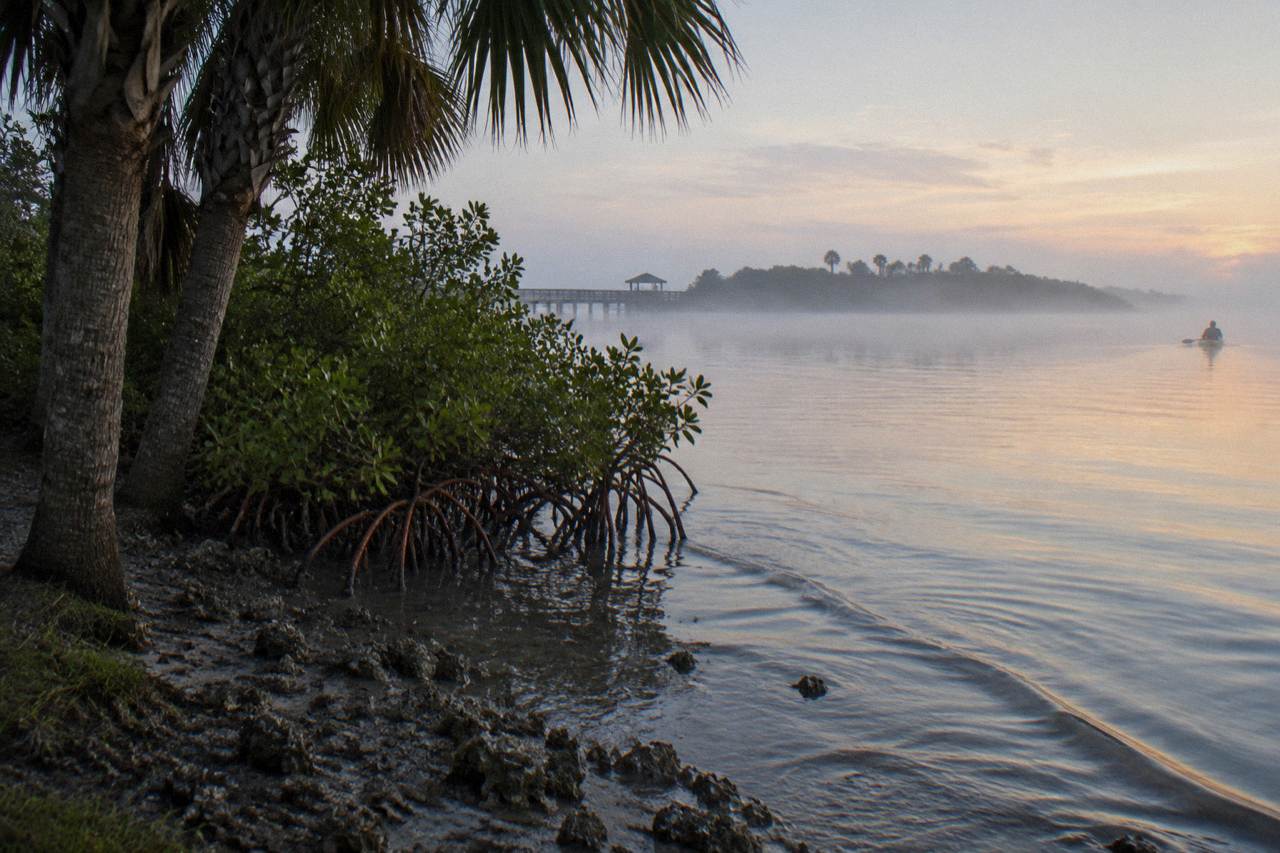
Alligators are part of everyday life in Florida, and Cocoa Beach sits on the edge of a huge lagoon system full of canals, ditches, mangrove channels and retention ponds, exactly the kind of fresh and brackish water alligators use. The Atlantic surf is a different world entirely: alligators are not ocean animals, and the beach itself is not gator habitat. So the short, honest answer is yes in the backwaters, effectively no on the sand, and the interesting question is really where the line falls and what it means for your dolphin tour or kayak paddle.
That line matters for travelers. People book a lagoon paddle, hear the word alligator, and wonder whether they are signing up for a wildlife documentary or a swim with something toothy. The reality is calmer than either extreme. This page walks through the actual habitat split around Cocoa Beach, what tour guides do when a gator appears on a route, how far away you should stay, and the parts of the Space Coast where an encounter is plausible versus vanishingly unlikely. Nothing here promises an alligator, and nothing here needs to scare you off the water.
Are There Gators In Cocoa Beach?
Yes, alligators can be present in the fresh and brackish waters in and around Cocoa Beach, including canals, ditches, mangrove channels and lagoon backwaters, and they are occasionally reported in the Banana River system. They are not animals of the Atlantic surf, and the beach and ocean frontage are not their habitat. An encounter is possible on the water, not likely on the sand. No verified count of alligators in Cocoa Beach exists, and this page will not invent one. What is verifiable is habitat: the American alligator occupies freshwater and brackish wetlands throughout peninsular Florida, and the patchwork of lagoons and canals behind the barrier island is exactly that kind of wetland.
The geography explains the split. Cocoa Beach is a barrier island, with the Atlantic Ocean on one side and the Banana River Lagoon on the other. The lagoon side is a shallow, sheltered estuary laced with mangroves, spoil islands, residential canals and stormwater ditches, many of them far fresher than the ocean and some only weakly salty. Alligators tolerate low-salinity water well, so the closer you get to freshwater inflows, canal mouths and the upper reaches of the system, the more plausible a gator becomes. Out on the open beach, in breaking waves and full-strength seawater, alligators are out of their element and sightings are rare enough to make local news when they happen.
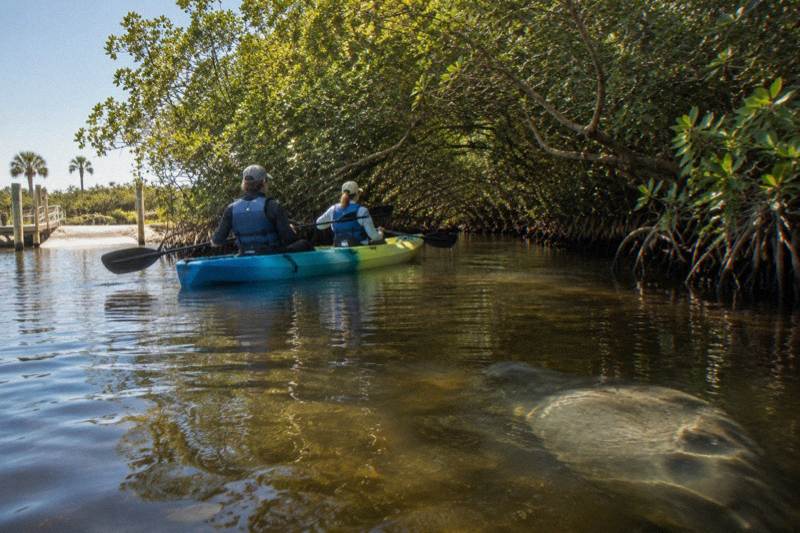
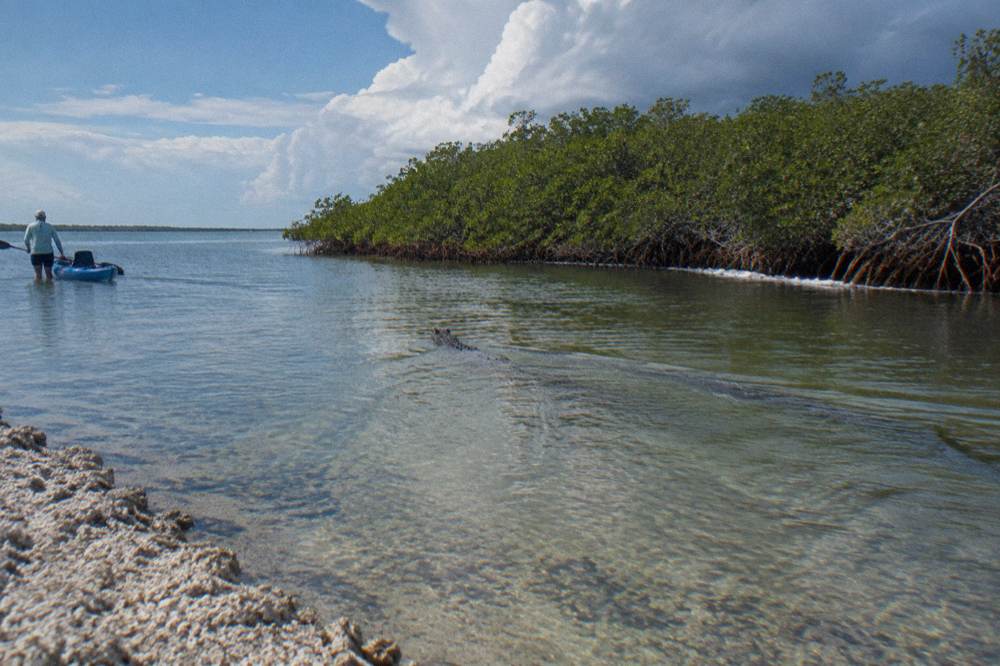
This is also why the question tends to come up around tours rather than sunbathing. The kayak routes around Cocoa Beach, the Thousand Islands mangrove maze, the Banana River flats and the refuge waters north toward Merritt Island all put paddlers into quiet, vegetated water where an alligator could live. The big motorized dolphin boats cruise wider, more open water where gators are far less at home. Where you paddle, and how sheltered the channel is, does most of the work of predicting whether a gator is even a possibility.
The practical takeaway for a visitor: the ocean side of Cocoa Beach carries essentially no alligator consideration, and you can swim, surf and walk the sand without thinking about them, while minding the ordinary rip-current and flag warnings. The lagoon side deserves a bit of awareness, the same kind you would apply anywhere in Florida's inland waters, and a guided tour is the lowest-effort way to get that awareness supplied by someone who knows the specific water. If a gator shows up on a route, guides have routines for it, and those routines are worth understanding before you book.
If you are weighing a lagoon paddle with that in mind, these three guided options cover the sheltered-water styles most visitors choose, all with a professional guide present the whole time:
Where Alligators Actually Live Around Cocoa Beach
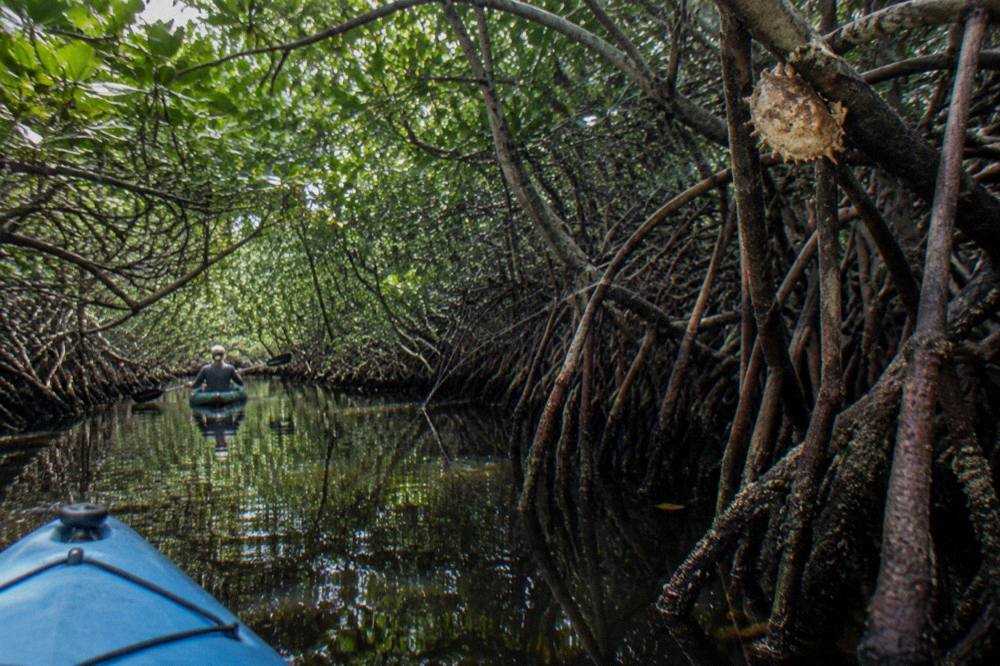
Alligators in the Cocoa Beach area stick to fresh and brackish water: residential canals, drainage ditches, retention ponds, the mangrove channels of the Thousand Islands, and the quieter, more vegetated reaches of the Banana River Lagoon. Full-strength ocean water, the surf zone and the open beach are not alligator habitat, and alligators there are the rare exception rather than the rule. The dividing line is salinity and shelter. Gators thrive where water is calm, vegetation is thick and prey is abundant, which describes the backside of the barrier island far better than it describes the coastline.
The Thousand Islands area is the classic local example. This cluster of mangrove islands and narrow channels lies just off Cocoa Beach's western shore, and its dead-end tunnels, mudflats and tangled roots are textbook reptile real estate: warm, quiet, full of fish and crabs, and connected to fresher water upstream. Paddlers here move slowly through confined channels, which is precisely why the guided mangrove tours exist. A guide who runs the same tunnels weekly knows which cuts hold manatees, where herons roost, and how to read a gator basking on a mudbank long before the group is close. The Mangrove Tunnels, Dolphins, Manatee tour is built exactly for this water: a 2 hour guided paddle from $64.82 per person, rated 5.0 from 898 reviews, with free cancellation and parking included, and a group capped at 11 so the guide can actually manage spacing in tight channels.
North of town, the pattern repeats at a bigger scale. The Merritt Island National Wildlife Refuge and the broader Indian River Lagoon system contain large areas of impounded marsh, brackish creeks and freshwater impoundments, habitat that supports alligators alongside the manatees, dolphins and birds the refuge is famous for. The refuge keeps an accessible Manatee Observation Deck and miles of slow wildlife drives where visitors watch from a vehicle or boardwalk, the safest possible vantage for any large reptile. For more on that side of the lagoon, see the guide to Merritt Island kayak launches and refuge wildlife.
What does not happen, in any reliable sense, is alligators hunting the beach. The surf zone has no cover, the salinity is punishing for a freshwater-adapted reptile over long exposure, and the food web is wrong. When an alligator does turn up in saltwater or on a beach in Florida, it is usually a transient individual moving between watersheds during drought, breeding season or a wander, and it typically moves on. Treating the Cocoa Beach shoreline as gator territory would be a category error. Treating the canal behind your rental or the pond by the strip mall that way would not be.
The table below sorts the common Cocoa Beach water types by how plausible an alligator sighting is in each.
| Water type | Location examples | Alligator plausibility | Why |
|---|---|---|---|
| Residential canals and ditches | Behind Cocoa Beach neighborhoods, US 1 corridor | Plausible | Fresh to brackish, slow water, abundant prey |
| Mangrove tunnels | Thousand Islands channels | Plausible, often brief sightings | Sheltered, vegetated, warm shallow water |
| Upper Banana River flats | Near Merritt Island, refuge impoundments | Plausible in quiet corners | Mix of fresh inflows and brackish marsh |
| Open Banana River dolphin boat routes | Wide water off the Causeway | Unlikely | Exposed, busier, less cover |
| Indian River Lagoon open water | Between causeways | Occasional, transient | Large brackish body, gators hug shorelines |
| Atlantic surf and beach | Cocoa Beach oceanfront | Effectively no | Full salinity, waves, no habitat value |
One nuance worth carrying with you: salinity is not a wall, it is a gradient. The same canal that is nearly fresh after heavy rain can be pushed saltier by drought and lagoon exchange, and alligators move accordingly. That is why locals describe gator presence as seasonal and patchy rather than fixed, and why no honest source will tell you a specific Cocoa Beach channel either always or never has one. For paddlers, the state's own safety rules are the anchor: Florida requires a wearable Coast Guard-approved life jacket for everyone on a kayak or paddleboard, worn by children under 6 and strongly advised for everyone else, per the FWC paddle-craft regulations page.
Do Dolphin Tours And Kayak Tours See Alligators?
Occasionally, yes, on the sheltered kayak and paddleboard routes through mangrove channels, canals and refuge waters, where alligators are part of the possible wildlife mix alongside manatees, dolphins, herons and rays. On the wide-open motorized dolphin boat routes off Cocoa Beach, alligator sightings are rare, because that exposed lagoon water is marginal habitat. Guides treat a gator like any other wildlife encounter: observe briefly, keep distance, move on. No tour on this site promises alligators, and no honest one could; wild animals decide their own schedules.
The practical difference between tour styles is worth spelling out. A motorized dolphin cruise, like the 2 hour Dolphin and Wildlife Tour from $38.99 per person (4.8 from 1,211 reviews), covers broad stretches of the Banana River where dolphins and manatees are the regulars. Passengers watch from a deck, the boat stays in open water, and a gator on the bank would be a bonus footnote, not an expectation. A kayak tour inverts the relationship: you are small, quiet and inside the vegetation line, in the habitat itself, which raises both the intimacy of the wildlife viewing and the need for the guide's judgment. That trade is exactly what many visitors are buying. For a fuller comparison of the two formats, the Cocoa Beach boat tours compared guide breaks down boat versus paddle for families and first-timers.
Guided kayak practice, described consistently across the lagoon's tour operators, is reassuringly boring. Guides brief paddlers before launch on staying together, not reaching hands into the water, and giving any large animal a wide berth. When a gator appears, the routine is to hold position or take a parallel line at distance, let the animal decide what it wants, and never pursue, corner or feed it. Feeding is not just rude, it is illegal for alligators in Florida, and a fed gator is the one that becomes a problem animal. The guides who work Cocoa Beach's tunnels weekly also simply know their water: which cuts to skip when, and when a basking animal wants the bank to itself.
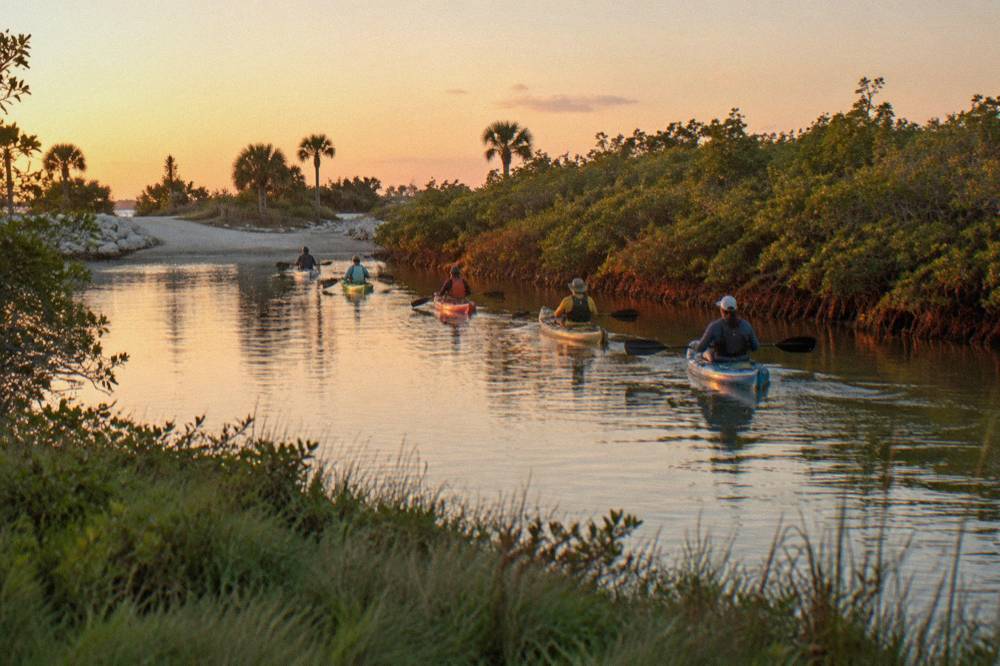
For paddlers choosing a route with this in mind, the roster offers a useful spread. The Manatee and Dolphin Kayak Tour launches from Ramp Road Park on the Banana River, includes kayaks, dry bags, sunscreen and bug spray, and runs about 2 hours from $50 per person (4.6 from 125 reviews) in groups up to 20. At the smaller end, the wildlife refuge paddle from the Merritt Island side caps groups at 10 and includes kayak, lifejacket, paddle and dry bags for a 1.5 hour outing from $100 per person (4.9 from 229 reviews). Group size is a real variable: in tighter mangrove channels, a small group is easier to reposition than a long train of boats, which is part of why the mangrove tours cap at 11 or 12.
It is also fair to ask what a night paddle changes, since summer bioluminescence tours run after dark. Visibility drops, but the guided format covers it: night tours in Florida carry the standard safety kit, including life jackets and a light ready to signal, consistent with the nighttime equipment rules on the FWC paddle-craft page. Alligators are most active in the warmer months and do much of their moving between dusk and dawn, so a night glow tour in June is a different sensory world from a 10 a.m. mangrove paddle. Guides who run those tours choose their launch points and timing with exactly this in mind.
How Close Is Too Close To An Alligator?
Stay tens of feet away at minimum, roughly the length of a good swim across a canal, and never approach, corner, feed or harass an alligator. On guided tours the guide sets and enforces the spacing. On your own, the test is behavior: if the animal hisses, slides off the bank, or moves toward you, you are too close, so back away calmly. The universal rule from Florida wildlife authorities is simple: never feed an alligator, and do not let one become comfortable near people.
The "behavior changes" test is the most useful tool a visitor can carry. A gator that is unaware or indifferent to you, basking with its mouth open on a far bank, or cruising a channel mid-distance, is behaving normally and poses essentially no threat to a paddler who keeps moving at range. An alligator that watches you fixedly, slides into the water and swims toward your boat, or holds its ground and hisses is telling you something, and the correct answer is distance, not photography. Telephoto lenses exist for a reason. So does the reverse rule: if you are close enough that a wild animal stops doing what it was doing, the encounter is over on your end regardless of how calm it seems.
A few concrete habits cover almost every realistic Cocoa Beach situation. Keep pets onshore or well contained; dogs resemble prey and provoke more alligator incidents than anything else in Florida. Do not swim in canals, ditches or lagoon backwaters, which are legal to boat on but unwise to swim in, for reasons that include boat traffic and water quality as much as wildlife. Watch children near any Florida waterbody, full stop. And when paddling, keep hands and feet inside the boat, which is standard kayak practice anyway. These rules are not Cocoa Beach specific; they are Florida-wide common sense that the lagoon's guides repeat at every launch briefing.
The legal backdrop reinforces the distance rule from both directions. Alligators are protected as a species managed by the state, feeding them is illegal, and the state runs a licensed nuisance-alligator program for animals that lose their fear of people. The same protective logic the region applies to manatees applies here in spirit: Florida law makes it unlawful to molest, harass or disturb manatees, per the FWC manatee viewing guidelines, and the wildlife-viewing ethic behind that rule, look, enjoy, withdraw, is the right template for every large animal in the lagoon, dolphins and manatees included. NOAA's marine life viewing guidance likewise tells boaters to stay at least 50 yards from dolphins, a number worth remembering if your gator question is really part of a broader "what's in this water" curiosity.
Are Alligators Dangerous To Swimmers And Paddlers?
Serious alligator attacks on people are rare in Florida given how many alligators and humans share the state, and guided tour groups are not a setting where incidents occur with any regularity. The risk that exists concentrates in specific behaviors: swimming in canals, walking pets at the water's edge, and feeding or provoking alligators. Avoid those and the residual risk is very small. The honest framing is risk management, not fear.
Start with what alligators actually eat and how they hunt. They are ambush predators keyed to prey roughly the size of fish, turtles, snakes, waterbirds and small mammals, taken at the water's edge. A kayak is a large, hard, unfamiliar object, and paddlers are not a food item. The scenarios that produce human injuries almost always involve an alligator that has been fed by people and has learned to associate humans with food, or a person swimming in murky fresh water, or a pet running a shoreline. None of those describe a briefed tour group in boats with a guide present. That is why Florida's guidance focuses so heavily on the feeding ban: the behavior chain that leads to problems starts with a human tossing food, not with a kayaker drifting past.
For visitors, the decision usually looks like this. If your plan is the beach, the surf and the pier, alligators simply do not enter the picture, and Cocoa Beach's ordinary beach safety advice is what matters. If your plan is a guided dolphin boat cruise, you are watching from a deck in open water, again a non-issue. If your plan is a kayak or paddleboard tour, you are doing the one activity where alligator habitat and recreation overlap, and you are doing it in the safest available format: a group, in daylight or a guided night window, with an operator who knows the route. The people who should think hardest are the self-guided: renters who paddle canals alone at dusk, or families letting kids splash at a canal-edge dock. Even then, actual incidents are rare, but the exposure is real, which is the precise gap a guided tour closes.
It helps to put the lagoon's wildlife in proportion. In a typical two hours on Banana River water, a tour group is far more likely to see bottlenose dolphins, manatees, pelicans diving, herons stalking mullet, and rays flipping than to have any meaningful alligator interaction. The lagoon's resident dolphin stock in the wider Indian River system is estimated at around 1,000 animals, per NOAA's stock assessment, and dolphin and manatee sightings are the tours' bread and butter, reported regularly and never promised. Alligators are the possibility, not the headline. The what to expect on a dolphin and wildlife tour guide covers the realistic sighting picture, and the question of whether tours ever promise sightings is answered plainly, as no, in do dolphin tours guarantee sightings.
When Are Alligators Most Active Around Cocoa Beach?
Alligators are most active in the warm months, roughly spring through early fall, and do most of their feeding and moving in the evening and at night, which is why daytime tours mostly see them basking motionless. Cool weather makes them sluggish and easy to miss entirely. For the best odds of a distant, peaceful sighting, book a warm-season paddle; in a winter cold snap, expect near-zero activity. Like every wild animal, they follow water temperature and daylight, not tour schedules.
The seasonal shape follows the sun. Warm late spring and summer water puts alligators at full metabolism: feeding, basking to regulate heat, breeding, and moving between ponds and canals. The June 2026 manatee mating gathering documented in the Indian River Lagoon near Cocoa is a reminder of how visible lagoon wildlife gets in early summer generally, warm months concentrate activity of every species in this system. As water cools in late fall and winter, alligators slow down and may hole up in burrows and deep holes, and a January paddle can feel almost sterile by comparison, even though the animals are still there. The lagoon's other calendar runs opposite in appeal: manatees gather at warm refugia in winter, and bioluminescence peaks in the hottest water of July and August, per the season guides on Cocoa Beach bioluminescence season and the best time to see dolphins and manatees.
Time of day matters almost as much as month. Alligators are most competent and most mobile between dusk and dawn, which is precisely when the summer bioluminescence tours run. That overlap is managed rather than feared: night tours launch from chosen sites, keep groups tight, carry lights and whistles, and stay in water the operators know. Daytime tours, including the popular morning and midday mangrove paddles, more often find alligators hauled out on a sunny bank, thermoregulating and profoundly uninterested in boats. For many visitors a motionless gator on a mudbank across a channel is the ideal version of the encounter: clearly visible, clearly distant, and a story rather than a heartbeat-raiser.
Weather adds a final layer. Heavy rain dilutes canals toward fresh and can spread animals out; drought concentrates everything into shrinking ponds and can push alligators to travel, occasionally through water they would normally avoid, which is when Florida sees its odd beach or pool visitor. Hurricane season, June 1 to November 30, can also shuffle things: storm surge and heavy inflow change salinity and water levels temporarily. Operators, not visitors, manage those calls; tour companies announce weather cancellations and route changes themselves, and a thunderstorm holds any paddle regardless of what the wildlife is doing. Book with free cancellation when your dates sit in the stormy season, and let the operator's go or no-go decision stand.
What Should You Actually Do Differently?
Almost nothing, if you are taking a guided tour: show up, listen to the briefing, keep hands inside the boat, and let the guide manage any wildlife encounter. If you are paddling or walking canals on your own, the changes are small and specific: keep distance from any basking animal, never feed anything, skip swimming in canals, leash pets, and prefer daylight to dusk in the warm months. The beach side of your trip needs no adjustment at all. Alligator awareness in Cocoa Beach is a ten-second habit, not a plan.
For most readers the answer collapses to a booking decision. A guided kayak tour converts the one genuinely overlapping activity, paddling sheltered lagoon water, into a managed experience, and it does so at prices that start around $50 per person on this roster. The mangrove tunnels tour pairs the sheltered habitat where a gator is most plausible with the smallest-group format and a guide alongside the entire time, plus complimentary photos and free parking, from $64.82 per person with free cancellation. The bioluminescence kayak tour covers the night version of the same question from $75 per person (4.8 from 928 reviews), also with free cancellation. Whichever you pick, the same briefing applies, and the same honest caveat: no operator on this water guarantees any wild animal, gator, dolphin, manatee or glow. Check availability on the live listing for current times and seats, since summer weekends fill first. The same logic runs through everything on Dolphin Tours Cocoa Beach, where every recommendation is a guided, bookable listing rather than a DIY suggestion.
Before the FAQ, here again are the three guided paddles this site compares most often for sheltered-water wildlife:
Common Questions About Alligators In Cocoa Beach
are there gators in cocoa beach?
Yes, alligators can be present in the fresh and brackish waters around Cocoa Beach, including canals, ditches and the Thousand Islands mangrove channels. The Atlantic surf and beach are not alligator habitat, and sightings there are rare exceptions. On sheltered lagoon water an encounter is possible; on the sand it is effectively a non-issue.
Will I see an alligator on a Cocoa Beach kayak tour?
Maybe, and only on the sheltered routes. Mangrove channel and refuge-area paddles occasionally pass a basking gator at a distance. Open-water dolphin boat cruises almost never do. No tour promises alligators; guides treat any sighting as a brief, managed bonus.
Is it safe to kayak in the Banana River with alligators around?
Yes, in the normal guided format. Alligators do not seek out kayaks, incidents involving tour groups are extremely rare, and guides keep distance from any large animal. Florida requires a life jacket per paddler, worn by children under 6. The behaviors that actually create risk are swimming in canals, feeding alligators and letting pets run shorelines, none of which happens on a tour.
What should I do if I see an alligator while paddling?
Hold your distance, do not approach or follow it, keep hands and feet inside the boat, and pass wide or wait. If the alligator changes its behavior because of you, back away calmly. Never feed one; feeding is illegal in Florida and creates the problem animals.
Do alligators go in the ocean at Cocoa Beach?
Not as habitat. Alligators are freshwater and brackish-water animals, and full-strength surf with breaking waves is outside their range. Occasional individuals appear in saltwater briefly while traveling, but the oceanfront is not where an encounter would realistically happen.
When is alligator activity highest near Cocoa Beach?
Warm months, roughly spring through early fall, with the most movement around dusk and night. In winter cold snaps alligators become sluggish and hard to find. A warm-season daytime paddle offers the best odds of a distant, peaceful sighting on a bank.