Is There Bioluminescence In Florida Right Now?
The honest answer to the right-now question about Florida bioluminescence: the season rule, the moon rule, and how to check a Cocoa Beach operator report before you book a night paddle.
The honest answer to "is the water glowing tonight" is never a simple yes or no, because bioluminescence near Cocoa Beach is a living thing that changes with the calendar, the moon, and the weather. Anyone who tells you the lagoon is bright "right now" without checking anything is guessing. What can be said with confidence is this: the Indian River Lagoon system, the Banana River, and the waters around Merritt Island host two different glowing organisms on a fairly predictable seasonal schedule, and tours run those waters almost every night of the year. The trick is knowing which organism is active, which nights are dark enough, and where to look for a same-day report. This page explains the season rule, the moon rule, and the checking rule, so you can answer the right-now question for yourself in about two minutes.
Is There Bioluminescence In Florida Right Now?
Bioluminescence is a year-round phenomenon in Florida's Indian River Lagoon, but its nightly visibility hinges on factors like the moon phase and recent weather. For the most reliable real-time answer, check a same-day report from a local kayak tour operator who paddled the lagoon recently. From roughly late May through early October, warm-water dinoflagellates light up the lagoons around Cocoa Beach and Merritt Island, with the densest glow usually in July and August. From roughly November through March, the show shifts to comb jellies, a softer, slower pulse. April and late October are transition months and genuinely unpredictable. No page can tell you what the water did tonight; an operator who paddled it yesterday can.
That season structure is the single most useful thing to internalize, because it turns a vague question into a calendar decision. If you are reading this in July, the odds of a bright dinoflagellate paddle near Cocoa Beach are about as good as they get anywhere in Florida. If you are reading this in January, the dinoflagellates are gone but the comb jellies are near their peak, and a night paddle still glows, just differently. If you are reading this in mid-April, nobody can promise you anything, and any operator who does is overselling.
The reason this stretch of coast works at all is the lagoon's geography. The Indian River Lagoon and its arms, including the Banana River beside Cocoa Beach, are shallow, warm, and relatively enclosed, which lets plankton populations build up instead of being flushed out. The same characteristics that make these waters calm enough for beginner kayakers make them the best bioluminescence theater in the state.
For choosing among the night paddles themselves, the site's bioluminescence kayak tours guide compares launch points, group sizes and prices in one place.
What Is Actually Glowing In The Water?
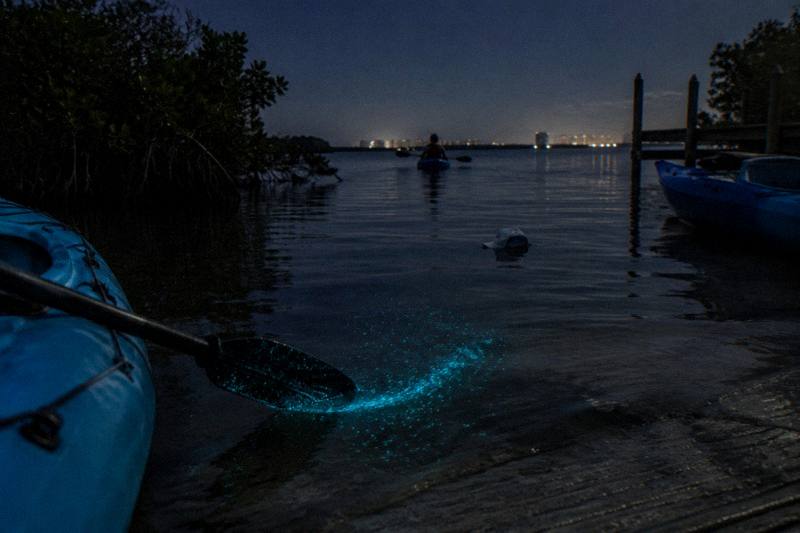
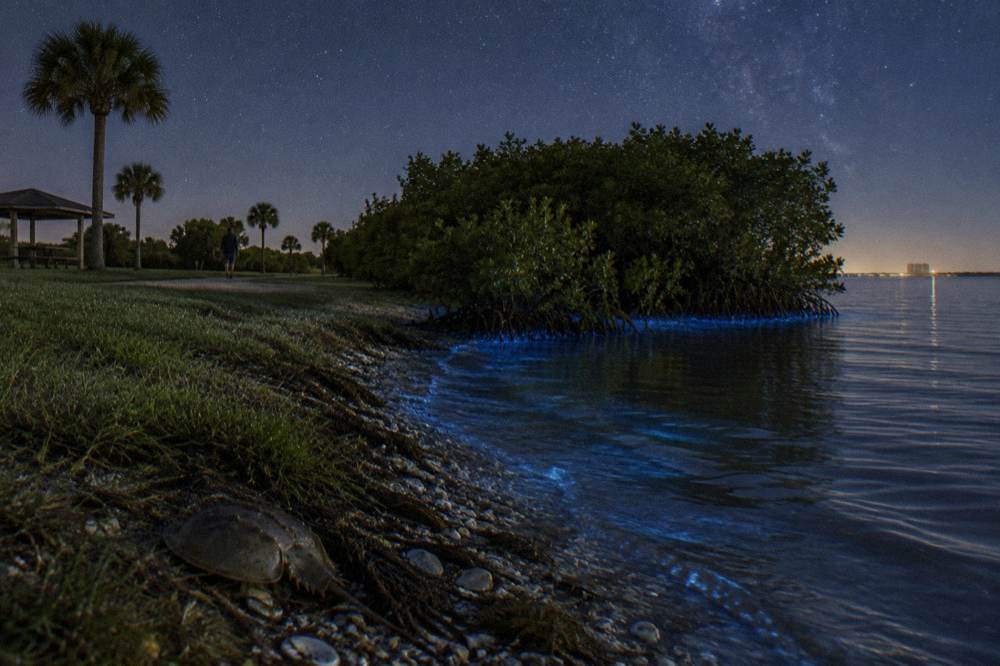
What glows in the water depends on the season: the light in the lagoons beside Cocoa Beach comes from two different organisms, with warm-season dinoflagellates flashing bright blue-green the instant the water around them is disturbed, and cool-season comb jellies pulsing with a softer, slower light instead. The dinoflagellate species here is Pyrodinium bahamense, a single-celled plankton that fires a short, electric spark of light whenever something moves the water around it: a paddle stroke, a fish, a hand trailed over the side. Comb jellies, or ctenophores, are animals rather than plants, do not sting, and glow like slow lanterns when touched by turbulence.
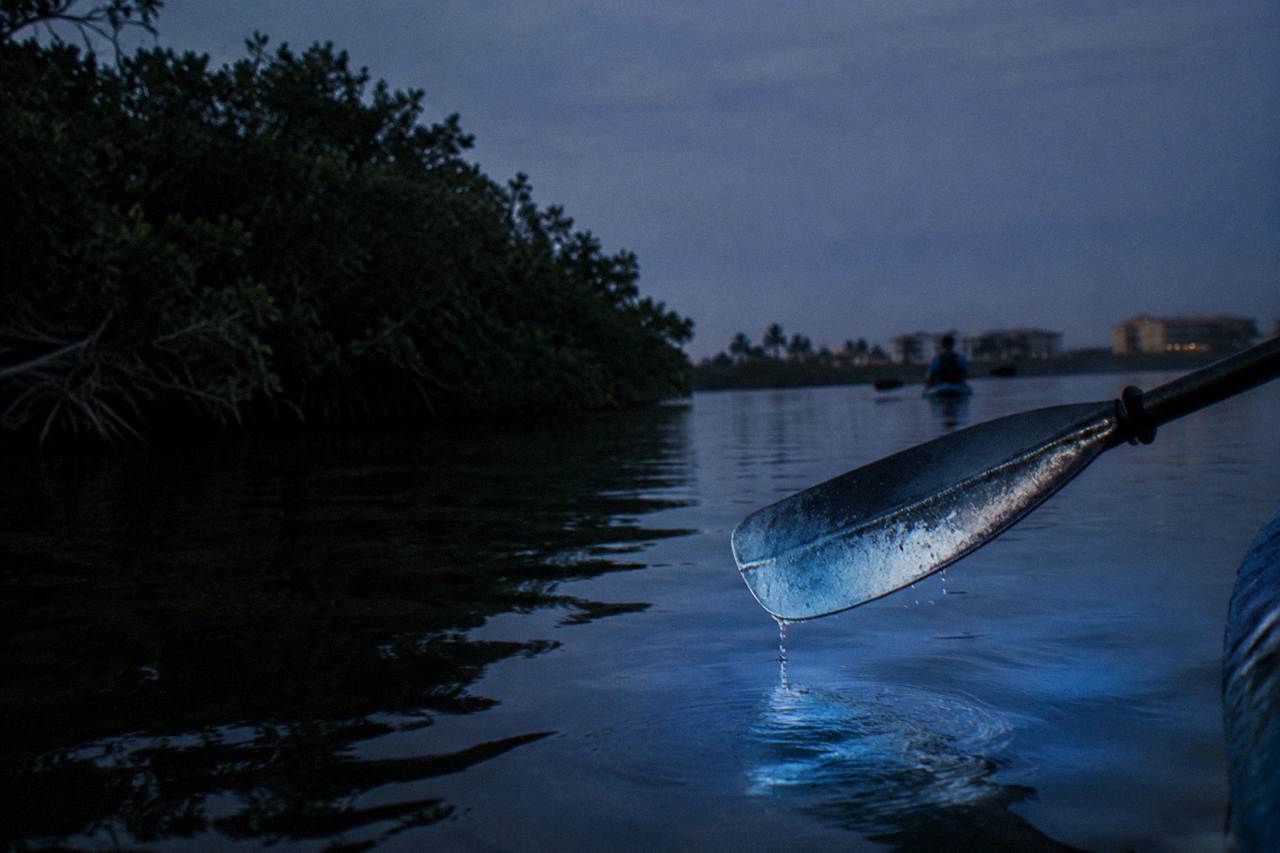
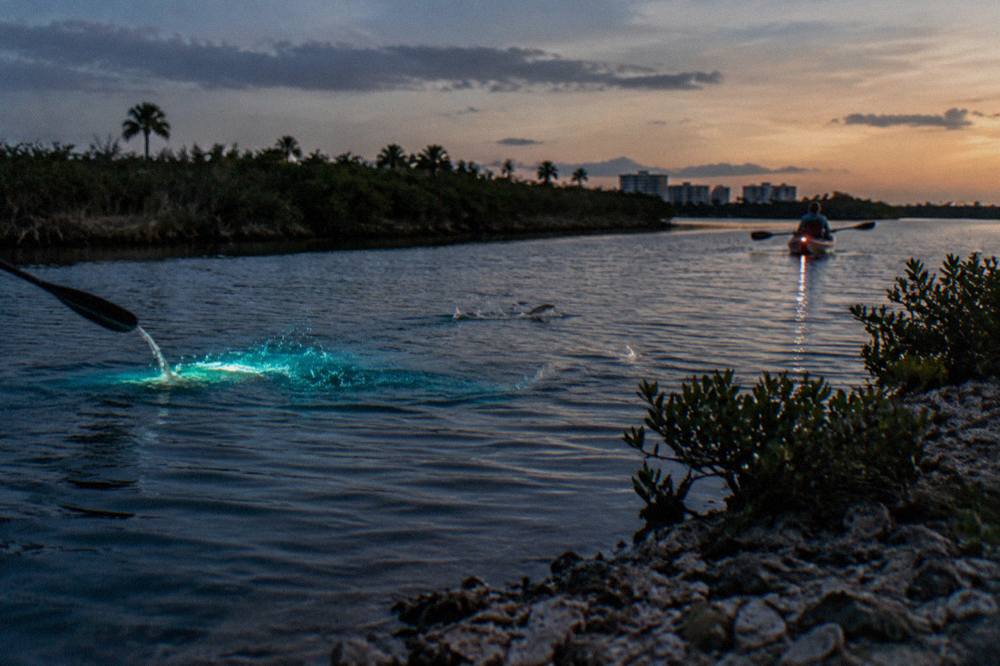
The two put on visibly different shows, and knowing which one is active tells you what your night paddle will look like. The dinoflagellate season is the famous one. Every paddle stroke leaves a blue-green comet trail, fish become streaking torpedoes, and on dense nights the wake behind the kayak looks like liquid light. Reviewers on the listings describe exactly this: manatee and dolphin shapes cutting glowing trails through dark water. It runs roughly late May to early October, peaking July and August when the water is warmest.
The comb jelly season is quieter but real, roughly November and December through February or March, often strongest in December and January. Instead of sparks, disturbed jellies bloom with a slow, diffuse glow that lingers a second or two. Photographers sometimes prefer it; thrill-seekers usually want the dinoflagellates. Late October into November, and again around March, the two populations can overlap or leave a lull, and that is the window where a same-day report matters most.
A note on what the glow is not: it is not a chemical spill, not a light show installed by anyone, and not guaranteed on any night. It is a wild plankton population that blooms, fades, and moves with the wind and tide. Operators track it daily because their business depends on it, which is exactly why an operator report is more reliable than any calendar.
When Does Each Type Of Bioluminescence Show?
Dinoflagellates run late May to early October with a July to August peak; comb jellies run November to March with a December to January peak; the shoulders of that schedule are the gamble months where a same-day report decides your night. The table below is the quick reference. Treat the edges as soft: a warm September can extend the dinoflagellate season, and a cold snap can start the jelly shift early.
| Month | Dominant glow | What it looks like | Reliability |
|---|---|---|---|
| January | Comb jellies | Slow, soft pulses, lantern-like | Good, often peak jelly season |
| February | Comb jellies | Soft pulses, fewer than December | Good |
| March | Comb jellies fading | Diminishing, unpredictable end | Mixed |
| April | Transition | Sparse either type, variable | Unpredictable |
| May | Dinoflagellates building | First sparks late in the month | Improving |
| June | Dinoflagellates | Bright trails on good nights | Good |
| July | Dinoflagellates, peak | Dense sparks, glowing wakes | Excellent |
| August | Dinoflagellates, peak | Dense sparks, fish trails | Excellent |
| September | Dinoflagellates | Strong, crowds thinning | Good |
| October | Dinoflagellates fading | Fading, possible jelly overlap | Mixed |
| November | Comb jellies returning | Soft glow building | Improving |
| December | Comb jellies | Soft pulses, often peak | Good |
The pattern behind the table is temperature. Pyrodinium bahamense blooms in warm water, which is why the season tracks the Florida summer so closely, and why the first cold fronts of October and November knock it back. Comb jellies tolerate, and prefer, cooler water, so they take over precisely when the dinoflagellates quit. Neither schedule is a secret, and every operator in the area plans their marketing around it.
If your travel dates are flexible, aim for July or August for the brightest show, or December and January for the jelly version with the smallest crowds. If your dates are fixed and fall in a shoulder month, book with free cancellation and check the report the day before. The bioluminescence season guide goes deeper on month-by-month planning.
Why The Moon Matters As Much As The Month
Because moonlight can wash out the water's faint glow just as easily as the wrong month can, the moon's phase matters every bit as much as the time of year; a bright full moon floods the sky with light from above, so the best nights fall within a few days of the new moon, when the sky is darkest and your eyes can adapt fully to the water's faint glow. Bioluminescence is faint light produced by tiny organisms, and it competes with every other light source: moonlight, dock lights, the glow of Cape Canaveral to the north. On a full-moon night in peak season, the water can be full of dinoflagellates and still look dull, because your eyes never fully dark-adapt and the ambient light overwhelms the sparks.
This is the detail that separates a good trip from a disappointing one, and it is entirely within your control. Before booking any night paddle, look up the moon phase for your date range and aim for the new moon window, roughly five nights either side. Operators run every night regardless, and honest ones will tell you a full-moon tour is a wildlife paddle more than a glow paddle. The moon also rises and sets on a schedule, so on some nights the moon is below the horizon for part of the tour; an operator who tracks this plans the launch time around it.
The dark-moon effect applies to both organisms. Comb jellies glow softly enough that moonlight hurts them even more than it hurts dinoflagellate viewing. A January new moon with a strong jelly population can outperform a mediocre August night under a bright moon.
Practical takeaway: pick your date by season, then adjust it by a few days toward the new moon. If the calendar forces a full-moon date, go anyway for the dolphins, the stars and the mangrove silence, and treat any glow as a bonus.
How To Check Today's Glow Report Before You Book
The reliable method is to read what local operators published in the last day or two, then book a tour with free cancellation on the listing and confirm conditions with the operator on the afternoon of departure, since they make the final weather and water call. Operators on the Space Coast paddle these waters nightly and post updates when the glow is unusually strong or weak. Their reports are business records, not tourist brochures, which makes them the best public signal available.
Here is the checking routine, step by step. First, confirm you are in the right season using the table above. Second, check the moon phase and steer toward the dark window. Third, search the recent posts or blog pages of Cocoa Beach and Merritt Island kayak operators for glow updates, and read what they said within the last week, not last year. Fourth, book a listing with free cancellation, of which there are several. Fifth, on the day of the tour, glance at the weather: thunderstorms cancel paddles, and operators announce cancellations themselves. More of these guides are collected on Dolphin Tours Cocoa Beach.
Weather deserves its own sentence. The Atlantic hurricane season runs June 1 to November 30, overlapping almost exactly with dinoflagellate season, and summer afternoon thunderstorms are routine even in quiet years. A tour operator, not this page and not a forecast app, makes the final call on whether a launch happens, and every listing here offers free cancellation so a weather call does not cost you the fare.
The featured night paddle on this site fits that routine well: the Bioluminescence Kayak Tour runs two hours from Kelly Park East on Merritt Island, from $75 per person, rated 4.8 across 928 reviews, with kayak, paddle and life jacket included and free cancellation on the listing. You can Check availability on the live listing once your date and moon line up.
Which Cocoa Beach Night Paddle Should You Book?
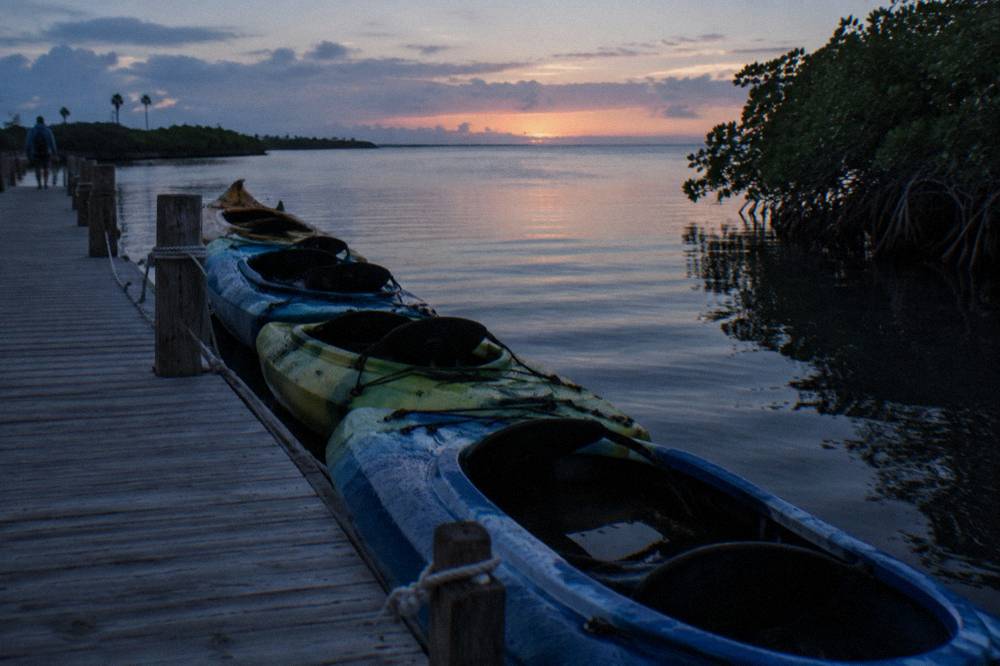
Match the launch point and group size to your priorities: Kelly Park East for the classic large-group tour, Kiwanis Island for a shorter option with a kayak or paddleboard choice, and Manatee Cove Park for the smallest groups on the water. The three bioluminescence listings this site tracks cover the main trade-offs: prices from $51.36 to $75 per person, durations from 1.5 to 2 hours, and group caps ranging from 9 to 42 paddlers.
The largest-capacity tour is the 2-hour Bioluminescence Kayak Tour from Kelly Park East, up to 42 paddlers, from $75. Big groups mean more boats stirring the water, which some guests love and photographers avoid. The Florida Bioluminescent Kayak and Paddle Board Adventure from Kiwanis Island gives you a choice of kayak or paddleboard, runs 1.75 hours with a group cap of 12, from $65, and the listing notes photos of your excursion are included. The Indian River Lagoon tour from Manatee Cove Park caps at 9 paddlers, from $65, making it the quietest option, and the listing includes a whistle and safety light alongside the standard gear.
Group cap matters more at night than it does by day. On a dark lagoon, the paddlers nearest you define your experience: a group of 9 glides through unbroken black water, while a group of 40 shares the glow but also the noise. Neither is wrong, and the price gap between them is ten dollars.
Safety rules are the same across all of them. Florida treats kayaks and paddleboards as vessels, requiring a wearable Coast Guard-approved life jacket per person, worn by children under 6, plus a sound-producing device and a light for night operation, per the FWC paddlecraft regulations. Every listing here includes the required gear, but knowing the rule lets you check. More on launch areas and refuge access is in the National Park Service's kayaking and boating page for Canaveral National Seashore, which borders the same lagoon system to the north.
A fourth option, Brady Yaks' 1.5-hour bioluminescent kayak tour from Merritt Island, runs $51.36 per person with a 4.5 rating across 167 reviews, the budget entry in the category, and the meeting point varies by option booked, so read the listing carefully. It rounds out a price range from $51.36 to $75 across the area's night paddles.
Can You Swim In Bioluminescent Water In Florida?
Swimming during bioluminescence tours is generally not part of the deal here, and the better question is what you may legally do around the protected animals that live in the glowing water, because dolphins and manatees in these lagoons are covered by federal and state law. The lagoon waters around Cocoa Beach are protected in multiple ways: the Banana River Aquatic Preserve, the Merritt Island National Wildlife Refuge, and federal marine mammal law all apply. Tour operators keep you in the kayak for good reasons, and the glow itself is best viewed from the surface anyway, where every paddle stroke paints a trail.
The animals matter more than the plankton. The same warm lagoons that glow in summer hold resident bottlenose dolphins and manatees year-round, and both are protected. NOAA's guidance is to stay at least 50 yards from dolphins when viewing from any watercraft, and feeding or harassing wild dolphins is illegal under the Marine Mammal Protection Act, as summarized on the NOAA marine life viewing guidelines page. Manatees are protected by the Florida Manatee Sanctuary Act: look, do not touch, do not feed, and if a manatee reacts to you, you are too close.
A night paddle with a guide handles all of this correctly, which is a quiet argument for booking one rather than renting a kayak alone. Guides know the idle-speed zones, keep the group together, and position you where the glow and the wildlife both are, without ever chasing an animal. The glow, by contrast, needs no protection from you: swirling a hand in the water is harmless to the plankton and is the whole point.
What A Bioluminescence Tour In Cocoa Beach Actually Costs
Night paddles around Cocoa Beach run from $51.36 to $75 per person for a seat on a guided tour, and the differences in that narrow band buy you duration, group size and launch point rather than a better glow. The cheapest listing in the category is Brady Yaks at $51.36; the most expensive standard tour is the Kelly Park East departure at $75. All of them include the kayak or paddleboard, paddle and life jacket, which means there is no gear rental to add on top of the listed fare.
What the price does not include varies by listing and is worth reading. Gratuities are excluded on some tours and included nowhere explicitly; bottled water is excluded on a couple of listings, so bring your own. Parking is free at the Tom Warriner Boulevard launch used by some daytime mangrove tours, while Kelly Park East and Kiwanis Island are Brevard County parks where posted signs govern any fees. City of Cocoa Beach beach-access parking runs paid daily 7 a.m. to 7 p.m., but the night-paddle launches sit on the Merritt Island side of the lagoon, outside that program.
Booking timing is its own lever. Peak-season dark-moon weekends fill first, and those are exactly the nights worth having. The standalone analysis in do I need to book a Cocoa Beach dolphin tour in advance covers the same logic for boat tours and it applies doubly to dark-moon bio nights, when every operator in the county is aiming at the same handful of dates.
If your heart is set on the brightest possible night, book the peak dark-moon date early with free cancellation, then watch the operator reports as it approaches. If the reports turn bad, cancel without cost and slide to the next dark window. That loop, more than any single tour choice, is how experienced visitors end up on the glowing water.
Common Misconceptions About The Glow
Three myths mislead people most: that the glow is constant all night and everywhere in the lagoon, that it is guaranteed once you are in season, and that it only happens in summer, leaving winter visitors assuming there is nothing to see. All three are false, and each one causes real disappointment for someone who booked on the wrong assumption.
The first myth: the glow is uniform. In reality, plankton patches drift with tide and wind, and one channel can burn bright while the next bay, ten minutes away, is dark. Guides move between spots for exactly this reason. A report that says "glowing at Kiwanis" tells you nothing about Manatee Cove.
The second myth: seasonal presence equals nightly intensity. Even in August, a storm that stirred the water the day before can scatter the bloom, and a bright moon can wash out what is there. No operator guarantees the glow, and a listing or review that promises it is overpromising. The correct expectation is "very likely, strong on good nights, variable always."
The third myth: no glow in winter. The comb jelly season is a real, bookable phenomenon from roughly November through March, and several of the same operators run it. It is a softer light show, but it is bioluminescence, and January nights are warm by most of the country's standards.
One more small one: the glow is not caused by pollution. Pyrodinium bahamense is a native plankton whose blooms have been documented in these lagoons for a long time, and while very dense blooms come with their own water-quality story, the light itself is a natural defense reflex, not a contaminant.
Common Questions About Bioluminescence Right Now
is there bioluminescence in florida right now?
It depends on the month, the moon and the day's conditions. From late May to early October, dinoflagellates make the lagoons around Cocoa Beach glow brightly, peaking July and August. From November to March, comb jellies provide a softer glow. Check the moon phase, aim near the new moon, and read what operators reported in the last day or two before booking.
Is there bioluminescence in Florida in winter?
Yes. From roughly November through March, comb jellies take over from the dinoflagellates and produce a softer, slower glow, often strongest in December and January. Night kayak tours in Cocoa Beach and Merritt Island run through winter for exactly this reason.
Does the full moon ruin bioluminescence?
It can. Bioluminescence is faint, and bright moonlight from above washes it out even when the water is full of glowing organisms. The best viewing is within about five nights of the new moon. Operators still run on full-moon nights, but the experience leans toward stars, mangroves and wildlife.
Can bioluminescence be guaranteed on a tour?
No. The glow comes from wild plankton populations that shift with weather, tide and temperature, and no honest operator guarantees it. Season and dark moons raise the odds a lot, but the correct expectation is very likely on a good summer night, never certain.
Where in Florida is the best bioluminescence?
The Indian River Lagoon system, including the Banana River next to Cocoa Beach and the waters around Merritt Island, is widely considered Florida's bioluminescence capital. Shallow, warm, enclosed water lets plankton build to display densities, and more night kayak tours launch here than anywhere else in the state.
Is it safe to kayak at night in the lagoon?
Yes, with a guided tour and the required gear. Florida requires a life jacket per paddler, worn by children under 6, plus a sound device and a light at night. The lagoon is calm, shallow and protected from open ocean swell, and guided bioluminescence tours supply all required equipment.