Bioluminescence Season In Cocoa Beach: Months, Moon Phases And When To Go
Cocoa Beach sits on the northern edge of one of the most reliable bioluminescent bays in North America. Here is when the glow happens, how the moon changes it, and how to plan a night paddle around it.
Short answer
The Cocoa Beach bioluminescence season runs roughly late May to early or mid October for dinoflagellates, the bright sparkler glow, with the densest blooms in July and August. Comb jellies glow more softly from roughly November or December through February or March. Book within five nights of a new moon for the darkest water and the best contrast.
Cocoa Beach sits on the western shore of a lagoon system that glows. On dark summer nights the water of the Indian River Lagoon and the Banana River flashes blue-green with every paddle stroke, every waking fish and every drip off a kayak blade. The effect comes from living organisms, which means it has a season, a life cycle and a schedule that no operator controls. This guide lays out that schedule: which months produce the bright dinoflagellate glow, which cooler months belong to the softer comb jellies, why the moon matters as much as the calendar, and what a night paddle actually costs. Before you lock in a date, our guide to checking Florida's bioluminescence in real time walks through the season rule, the moon rule and how to read a Cocoa Beach operator report.
The short version: the dinoflagellate season runs roughly late May to early or mid October, densest in July and August, and the comb jelly window runs roughly November or December through February or March. A dark or new moon night inside either window gives you the best contrast. For the full tour-by-tour breakdown, see the companion bioluminescence kayak tours guide.
When Is Bioluminescence Season In Cocoa Beach?
The Cocoa Beach bioluminescence season has two overlapping chapters: dinoflagellate algae glow brightest from roughly late May to early or mid October, peaking in July and August, while comb jellies produce a softer glow from roughly November or December through February or March. The transition weeks in late October and November, and again in March, are unpredictable, with either organism possible or neither dense. No operator guarantees a glow.
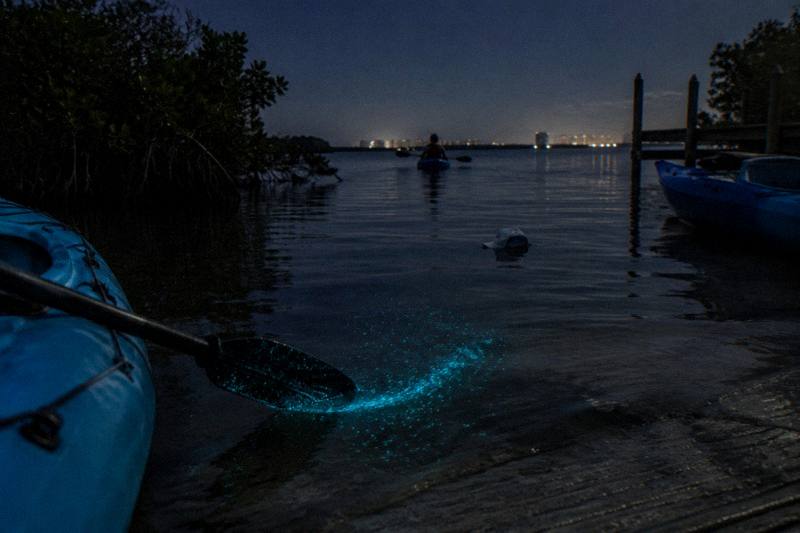
The bright summer glow comes from a dinoflagellate called Pyrodinium bahamense, a microscopic alga that flashes blue-green light when the water around it is disturbed. Warm water is what drives its density, which is why the peak lands squarely in the hottest weeks of a Florida summer, July and August, and why the season fades as the lagoon cools in early to mid October. A paddle stroke, a fish darting under the hull, a hand trailed in the water, each one triggers a burst of light.
The winter chapter belongs to comb jellies, or ctenophores. These are gently glowing animals rather than flashing algae, and they produce slow, lantern-like pulses rather than sparks. They are non-stinging and become more prominent as the water cools. The two glows feel different enough that some paddlers deliberately chase both: the sparkler show in August, the lantern show in January.
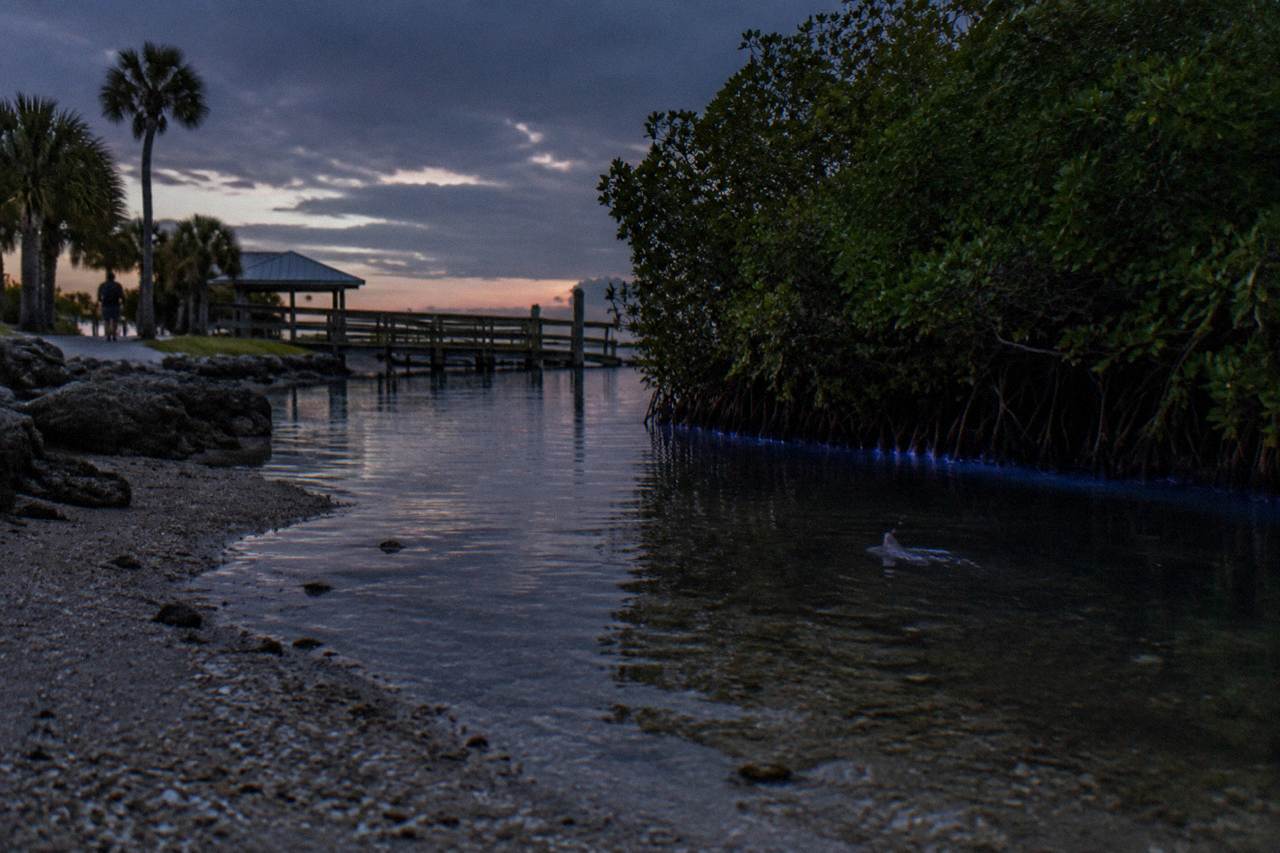
Because both organisms are wild, density varies night to night with water temperature, salinity, wind and recent rain. Operators track the water closely and sometimes move launches when glow levels drop at one site, which is exactly why several Cocoa Beach and Merritt Island tours list alternate launch points on their listings. Treat every date range here as a window, not a promise.
The Two Glows: Dinoflagellates Versus Comb Jellies
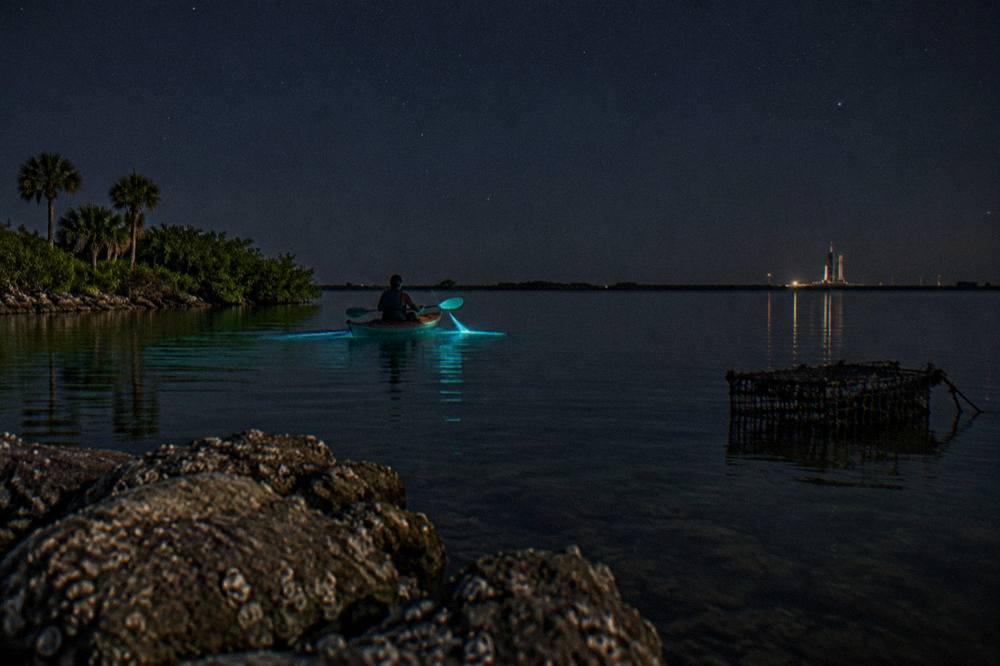
Dinoflagellates flash on contact: a paddle stroke breaks into sparks and a moving fish leaves a glowing streak, which is why summer paddles feel like floating through fireworks. Comb jellies glow from within, pulsing slowly like submerged lanterns when disturbed. The first is dramatic and movement-driven, the second is subtle and animal-driven, and each has its own band of the calendar.
The distinction matters for what you book. On a dinoflagellate night, the water itself appears to ignite: spray off a paddle blade lights up, the wake behind the kayak glows for several seconds and manatee or dolphin movement nearby can light up a whole channel. Reviews of the area's night paddles describe the glow following every motion of the boat, which is the signature of a dense Pyrodinium bloom. That is the July and August experience, reliable through June and September and into early October in a warm year.
Comb jelly nights are quieter. The jellies drift in the water column and flash a soft blue-green when a hull or hand passes near them, so the experience is one of finding and stirring them rather than of the whole bay igniting. Peak comb jelly months are usually December through February, with the window opening around November or December and closing around February or March. Photographers often prefer the comb jelly season because a slow pulse is easier to capture than a millisecond flash.
There is no verified sighting-rate data for either organism in this lagoon, so any percentage a blog quotes you is invented. What the record does support: the season boundaries above, the July and August dinoflagellate peak, the December to February comb jelly peak, and the fact that operators run bioluminescence paddles in both windows. What one night delivers depends on the water that night.
If the difference between the two still has you weighing which to chase, the is bioluminescent kayaking worth it post walks through what a night paddle actually feels like against its cost.
The Season Month By Month
June through September are the dependable dinoflagellate months, with July and August the peak and the densest, brightest blooms. May and early October are shoulder months: the glow is usually present but thinner. November into March is comb jelly time, strongest December through February, and late October, November and March are transition months where either organism or neither may dominate.
The ribbon below reads as a planning tool, not a forecast. It reflects the seasonal pattern reported by Space Coast operators and local coverage, and it deliberately avoids any sighting-rate claim, because no such data exists for this lagoon. Use it to pick a month, then let the moon phase narrow your dates.
| Month | What glows | How strong | Notes |
|---|---|---|---|
| January | Comb jellies | Good | Peak comb jelly window, coldest water |
| February | Comb jellies | Good to fading | Late-month warmth can start transitions |
| March | Transition | Unpredictable | Either organism possible |
| April | Little to none | Weak | Off season for both glows |
| May | Dinoflagellates begin | Building | Late May usually marks the season opening |
| June | Dinoflagellates | Good | Warm water, school-vacation crowds |
| July | Dinoflagellates | Peak | Densest blooms of the year |
| August | Dinoflagellates | Peak | Peak continues, popular month |
| September | Dinoflagellates | Good to fading | Thinner crowds, glow still present |
| October | Dinoflagellates fading | Shoulder | Early month best, transition by late month |
| November | Transition to comb jellies | Unpredictable | Either organism possible |
| December | Comb jellies | Building to good | Comb jelly season establishing |
A practical read of the table: if you want the famous bright-blue sparks and you can only travel in one window, aim for mid July to late August. If you hate crowds as much as you love the glow, late September keeps most of the dinoflagellate season with a fraction of the summer bookings, and operators often still report strong glow. If your trip lands in winter, book the comb jelly paddle expecting a slower, quieter show rather than fireworks.
The question of which single month is best comes up constantly, and the answer depends on which glow you want; the what month is bioluminescence in Florida post takes that question head on.
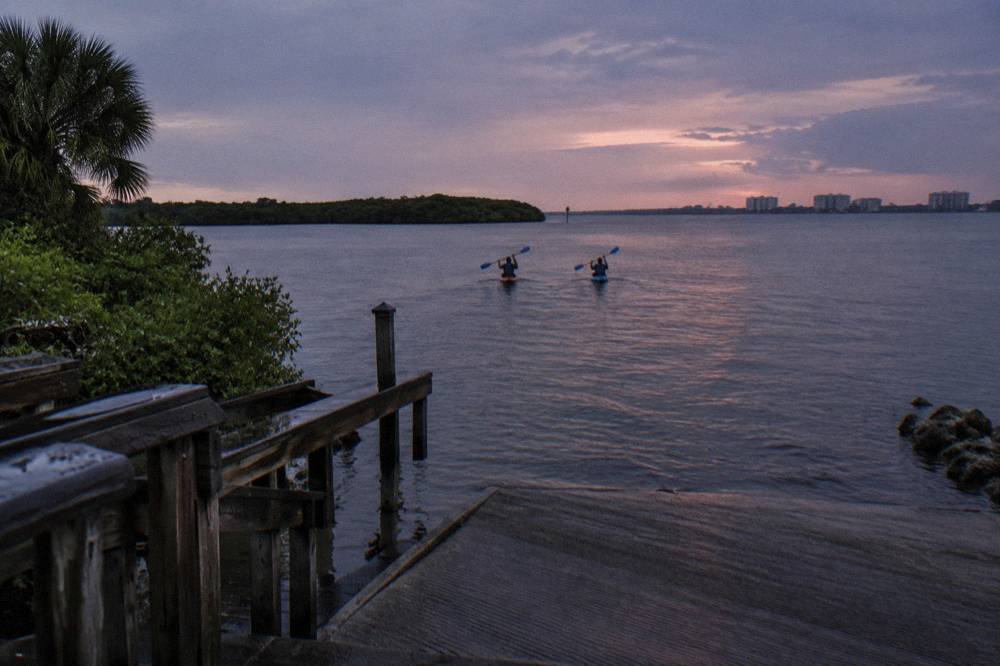
Why The Moon Phase Matters As Much As The Month
The glow does not get brighter on a new moon, the sky gets darker, and dark water is what makes a bloom visible. Within three to five nights of a new moon, or any night the moon sets early or stays below the horizon, contrast peaks and the same organisms look dramatically better. Around a full moon the glow can be present and still hard to see.
This is the single most useful planning fact in this guide, and it is pure optics. Pyrodinium flashes are brief and blue-green, and moonlight on the water surface washes them out the same way city light washes out stars. A dense bloom on a full-moon night can look mediocre, while a modest bloom on a moonless night can look extraordinary. Operators run tours on every night of the cycle, but the darkest windows fill first, and experienced paddlers chase the new moon the way skiers chase fresh snow.
| Moon phase | Sky over the launch | How the glow reads | Booking reality |
|---|---|---|---|
| New moon (and 3 to 5 nights around it) | Darkest | Same bloom looks its brightest | Fills first, book early |
| Crescent moon | Dark for part of the night | Very good, especially before moonrise | Popular, book ahead |
| First quarter | Moon up half the night | Good early, washed out after moonrise | Moderate availability |
| Full moon (and nights near it) | Bright all night | Glow present but muted | Usually easy to book |
| Moon sets early or below horizon | Dark mid-tour | Reads like a new-moon night | Operator schedules vary |
The practical move is a two-step check. Pick your month from the ribbon above, then find that month's new moon and book a night inside the three to five nights around it, ideally with a start time the operator has set for full darkness. Tour listings state their departure times, and operators shift them through the year as sunset moves; if a listed start looks early for a summer date, that is because Florida sunsets are late, not because the tour skips the dark.
One more optical note: cloud cover cuts both ways. A heavily overcast sky with no moon can be nearly as dark as a new-moon sky, but the same clouds hide the stars that make these paddles memorable, and stormy weather cancels tours outright. The operators make the call on weather, and they announce cancellations, not this site and not the calendar.
What A Night Paddle Costs And Which Tours Run
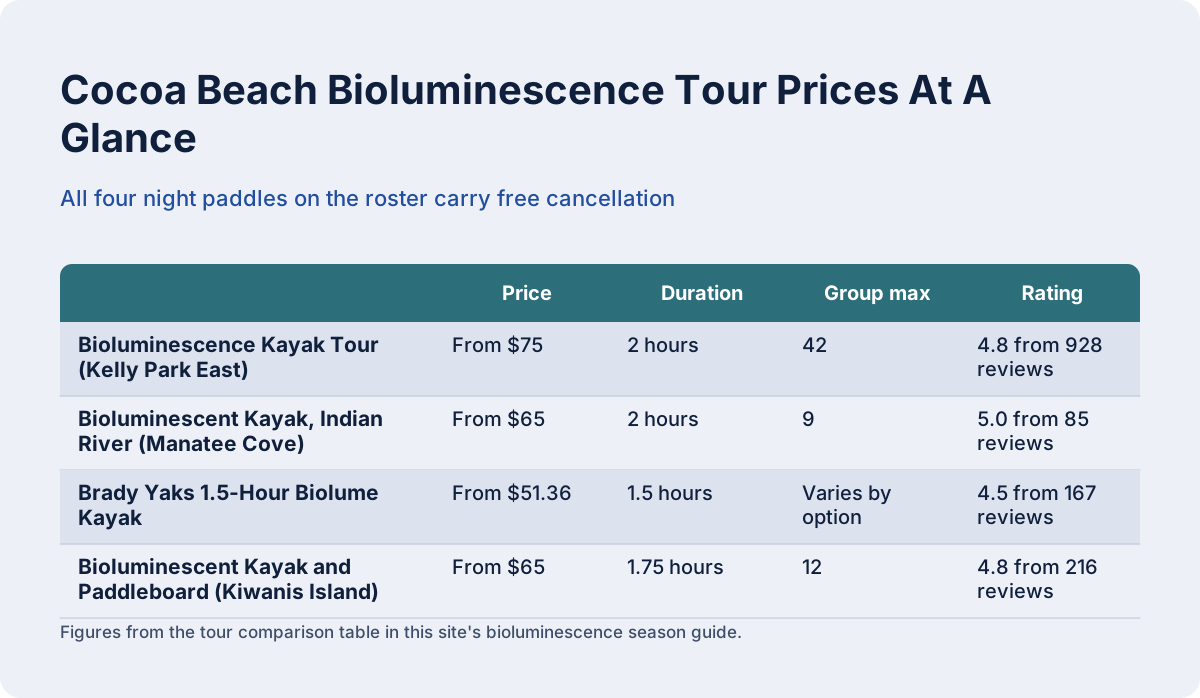
Bioluminescence paddles around Cocoa Beach and Merritt Island run from $51.36 to $75 per person, in groups as small as 9 or as large as 42, and most last 1.5 to 2 hours. Every bio tour on this site's roster carries free cancellation. The trade-off is simple: smaller groups cost similar money but book out fastest near new moons.
The roster's night paddles break into three practical shapes. The flagship 2-hour bioluminescence kayak tour, rated 4.8 from 928 reviews, launches from Kelly Park East at $75 per person and carries up to 42 paddlers, which makes it the easiest to book late and the most social option on the water. A smaller alternative from Manatee Cove Park, rated 5.0 from 85 reviews, also runs $65 per person with a group cap of just 9, the most intimate bio trip listed here. And the Brady Yaks 1.5-hour paddle, rated 4.5 from 167 reviews, starts at $51.36 per person with launch points that vary by option, a good value pick for a first night paddle.
| Tour | Price | Duration | Group max | Rating | Cancellation |
|---|---|---|---|---|---|
| Bioluminescence Kayak Tour (Kelly Park East) | From $75 | 2 hours | 42 | 4.8 from 928 reviews | Free |
| Bioluminescent Kayak, Indian River (Manatee Cove) | From $65 | 2 hours | 9 | 5.0 from 85 reviews | Free |
| Brady Yaks 1.5-Hour Biolume Kayak | From $51.36 | 1.5 hours | Varies by option | 4.5 from 167 reviews | Free |
| Bioluminescent Kayak and Paddleboard (Kiwanis Island) | From $65 | 1.75 hours | 12 | 4.8 from 216 reviews | Free |
Booking follows the season. Inside the July and August peak, and within a few nights of any summer new moon, the small-group trips fill first and the 42-person launches are what is left. Shoulder months are calmer, but operators also run fewer departures once demand drops, so late September and October dates still benefit from booking ahead. The full decision walkthrough lives in the bioluminescence kayak tours guide.
The paddleboard option deserves a line of its own. The Kiwanis Island bioluminescent kayak and paddleboard trip, from $65 per person and rated 4.8 from 216 reviews, lets you choose a board or a kayak at the same launch, and a paddleboard puts you closer to the water than anything else on this list, which on a dense night means the glow practically underfoot. Its listing notes an alternate launch can be used if bio levels drop, a common operator move in this fishery.
Weather, Water Quality And Safety On A Night Paddle
The lagoon's bioluminescence paddles are beginner-friendly protected-water trips, and Florida law treats kayaks and paddleboards as vessels requiring a wearable life jacket per person, worn by children under 6, plus a sound-producing device and a light at night. Tour operators supply all of it. Thunderstorms cancel tours, and the operator, not the calendar, makes that call.
Summer in Florida means afternoon thunderstorms, and the Atlantic hurricane season runs June 1 to November 30, which brackets the entire dinoflagellate window. Night paddles usually launch after the typical storm pattern has passed, but unstable evenings get scrubbed, and operators announce cancellations and rebooking directly. Free cancellation on every bio tour on this roster means a weather scrub costs you the inconvenience, not the fare. The state's paddle-craft requirements are spelled out by the Florida Fish and Wildlife Conservation Commission, and every listed tour includes the required gear: life jacket, whistle and a safety light on the night trips.
Water quality in the Indian River Lagoon varies, and the honest answer is that it varies in ways no visitor page can state as a current fact. The lagoon has a long documented history of phytoplankton blooms tied to excess nutrients, the same dynamics that collapsed its seagrass meadows after 2009 and triggered the manatee starvation event of 2020 to 2022. That event was formally declared over in March 2025, and the recovery is real: seagrass mapping by the water management district measured 17,042 hectares of lagoon seagrass in 2025, up from 9,924 hectares in 2023, more than 7,000 hectares of regrowth in two years. Healthier seagrass supports the grazers and fish whose movement lights up a glow, so the recovery is quietly good news for the whole night-paddle ecosystem.
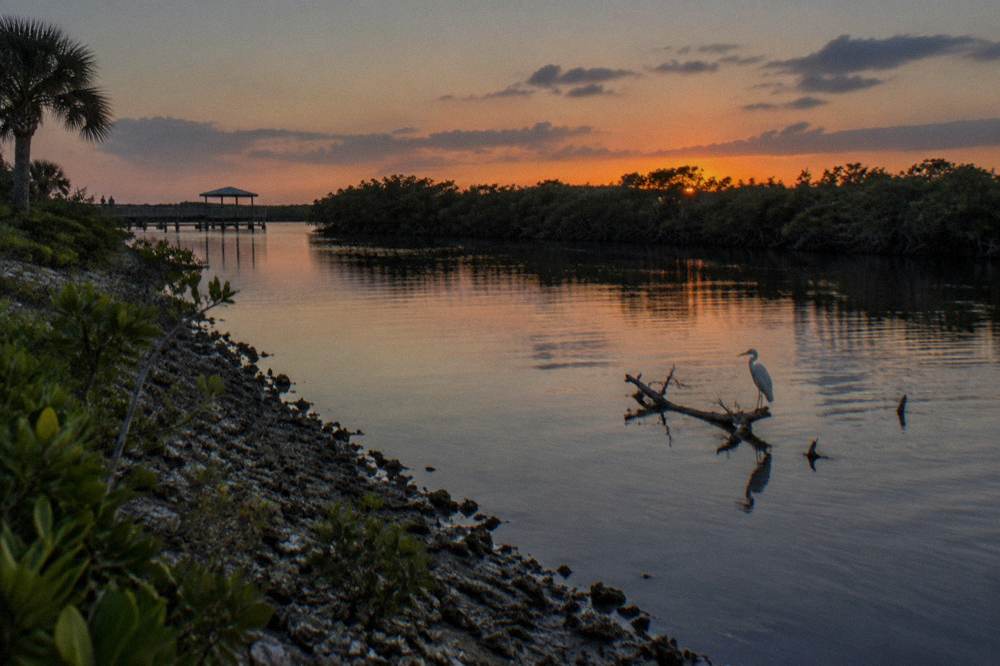
Launch access matters too. Night paddles launch from designated ramps and parks: Kelly Park East, Manatee Cove Park, Kiwanis Island Park and operator-selected alternates, all inside the lagoon system rather than the open ocean. Kayaking in the neighboring Canaveral National Seashore is permitted at designated ramps, and the refuge lands across the lagoon, including the Merritt Island National Wildlife Refuge around Haulover Canal, remain year-round slow-speed manatee zones. Tours navigate all of this for you; independent paddlers should check ramp rules before launching after dark.
Planning A Trip Around The Glow
Pick the month first, the moon second and the tour third. July and August with a new moon within five nights is the maximum-glow play; December through February is the comb jelly play; late September is the value play with most of the season intact. Book the small-group trips early in peak months, and keep a weather-flexible mindset between June and November.
Families traveling on school breaks usually land in June or July, and both work, with the caveat that June glow is typically thinner than August. Couples and photographers with flexible dates should target the new-moon windows and accept a midweek departure to escape weekend bookings. Winter visitors, snowbird season in January and February, get the comb jelly show and often calm, cool, bug-free nights that summer paddlers would envy, though the water is at its coldest.
Bug spray is a summer-night essential the listings themselves hint at, and one operator's listing asks paddlers to apply sunscreen before arrival on day tours and to bring bug spray for night tours. Dress for the season, bring water where the listing excludes it, and expect to get at least your hands wet: half the fun on a dense night is trailing fingers through glowing water. The what-to-wear details are covered in full in the what to wear on a Cocoa Beach boat or kayak tour post.
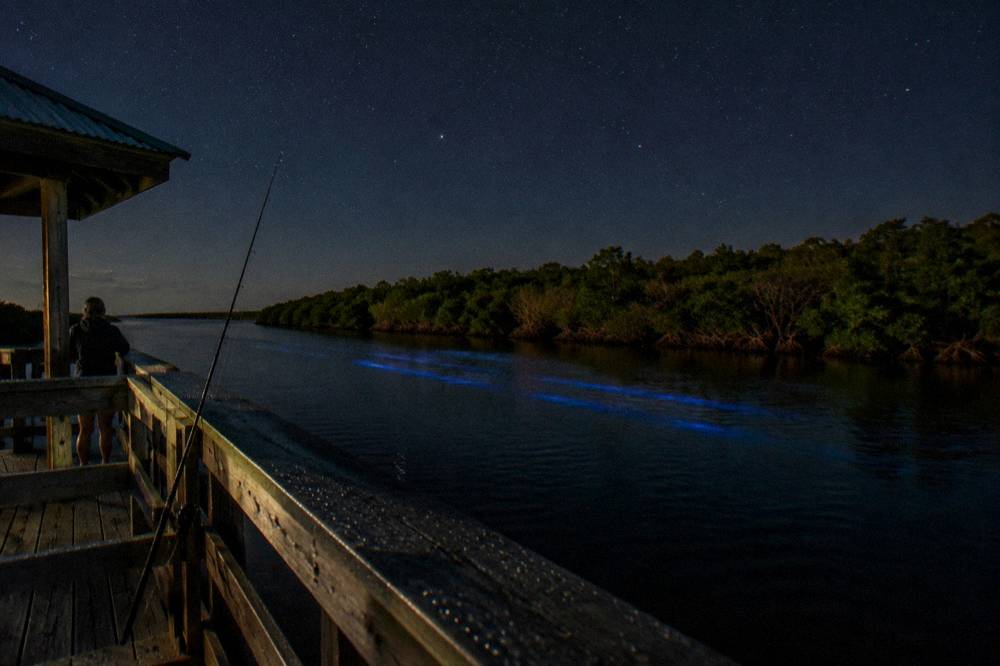
One planning note that surprises first-timers: the glow is best away from city light, and the launches are deliberately placed on the Merritt Island side of the lagoon for that reason. That means a drive of roughly 15 to 25 minutes from central Cocoa Beach depending on the launch, so a 9 p.m. departure means leaving your hotel by 8:15. The featured 2-hour bioluminescence kayak tour meets at Kelly Park East, where the dock and the parking sit a short walk apart, and the tour includes kayak, paddle and life jacket.
Common Questions About Bioluminescence Season
When is bioluminescence season in Cocoa Beach?
The dinoflagellate season, the bright sparkler glow, runs roughly late May to early or mid October, densest in July and August. Comb jellies glow more softly from roughly November or December through February or March, usually strongest December through February.
What is the best month to see bioluminescence in Cocoa Beach?
Mid July through August for the bright dinoflagellate glow, and December through February for the softer comb jelly glow. Both windows are best within a few nights of a new moon, when the dark sky maximizes contrast.
Does the moon phase affect bioluminescence?
Yes, through visibility rather than brightness. A new or dark moon, or a night the moon sets before your paddle, makes the same glow look far brighter because nothing washes out the water surface. Full-moon nights can hide an otherwise dense bloom.
Can you see bioluminescence in Cocoa Beach in winter?
Usually yes, from comb jellies rather than dinoflagellates. Roughly November or December through February or March, non-stinging comb jellies pulse with a soft blue-green light. The show is slower and subtler than the summer sparks.
Do bioluminescence tours guarantee seeing the glow?
No. Dolphins, manatees and bioluminescence are all wild and variable, and no operator guarantees any of them. Booking inside the seasonal windows near a new moon is the best way to raise your odds, and every bioluminescence tour on this roster offers free cancellation if plans change.
How much does a bioluminescence kayak tour near Cocoa Beach cost?
Between $51.36 and $75 per person on this site's roster, for trips of 1.5 to 2 hours. Group sizes run from a cap of 9 paddlers up to 42, and all of the listed bio tours include free cancellation.
The glow is the headline, but it is not the whole show: the same lagoon hosts resident bottlenose dolphins and manatees by day, and the best time to see dolphins and manatees in Cocoa Beach pairs neatly with a night paddle for a full day on the water. Whatever month you choose, book the darkest night you can, Dolphin Tours Cocoa Beach keeps the live listings current, and let the lagoon do the rest.