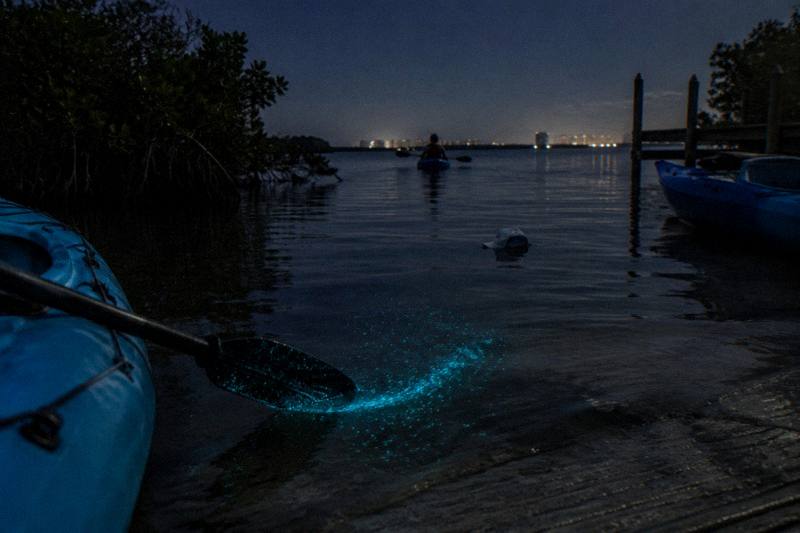
What Month Is Bioluminescence In Florida?
The month-by-month answer for Florida bioluminescence on the Space Coast: peak dinoflagellate glow in July and August, reliable season June to early October, comb jellies in the cool months, and which Cocoa Beach night tours to book.
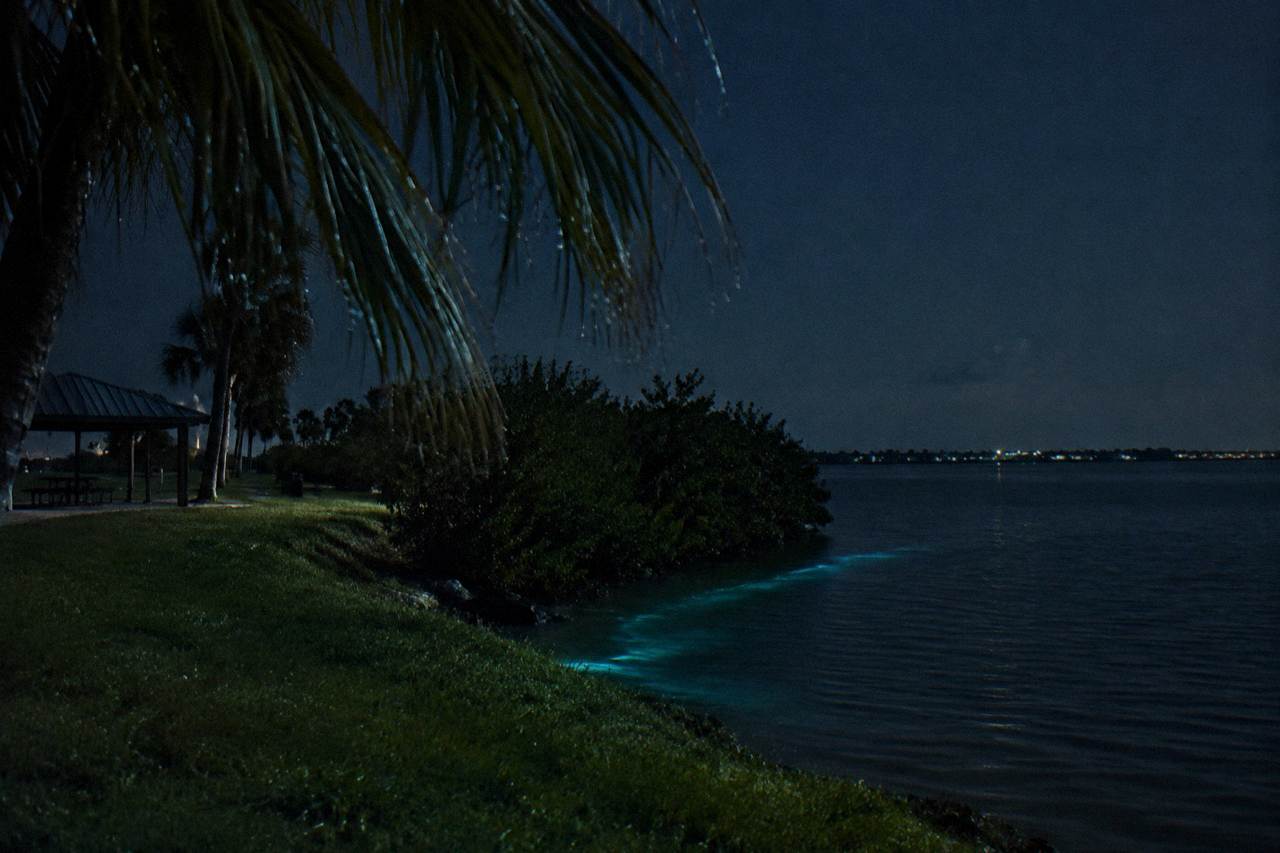
Florida's most reliable bioluminescence sits in the lagoon system behind Cocoa Beach and Merritt Island, and the month you pick changes what you see. The warm months bring dinoflagellates, single-celled organisms that flash bright blue-green when a paddle stroke or a fish disturbs the water. The cool months bring comb jellies, which glow with a softer, slower pulse. Pick the wrong month and the lagoon can look ordinary. Pick the right one, in a dark moon window, and every stroke lights up. Before you book a tour, it helps to check whether there is bioluminescence in Florida right now, since recent operator reports tell you which night the water is actually lighting up.
This page lays out the full calendar: which months glow brightest, when the season starts and fades, how the moon fits in, and which Cocoa Beach night paddle tours are worth booking in each window.
What Month Is Bioluminescence In Florida?
July and August are the peak bioluminescence months in Florida, when dinoflagellate blooms reach their densest in the warmest water of the Indian River Lagoon near Cocoa Beach. June through September is the reliable window, with early October still capable of a strong showing before the season fades. From roughly November through March the show belongs to comb jellies instead.
The two organisms behave nothing alike, and understanding that split answers most of the month question on its own. Dinoflagellates, the species responsible for the famous sparkler effect, are warm-water organisms. They multiply through late spring, hit peak density in the heat of July and August, and decline as water temperatures fall in October. Comb jellies are not algae at all but soft, non-stinging drifters whose bodies flash a lantern-like blue-green when touched by a paddle or a passing fish, and they tolerate, even prefer, the cooler months.
That handoff happens somewhere in late October and November, and it is unpredictable. A late October paddle might catch the tail of the dinoflagellate bloom, a first wave of comb jellies, both at once, or, in a bad week, not much of either. Locals call transition periods a gamble for a reason. If your travel dates are fixed rather than flexible, the safest planning move is simple: book a June through September night paddle for the bright glow, or a December through February trip for comb jellies, and treat the shoulder weeks as a bonus rather than the plan.
The geography matters as much as the calendar. The glow concentrates in the shallow, calm waters of the Indian River Lagoon system, including the Banana River and Mosquito Lagoon, all within a short drive of Cocoa Beach. Deeper, darker ocean water does not produce the effect at anywhere near the same intensity, which is why every glow tour in this region is a lagoon kayak or paddleboard trip rather than a boat cruise.
If you are weighing the experience itself rather than the timing, the companion piece on whether a bioluminescent kayak tour is worth it breaks down what the money buys.
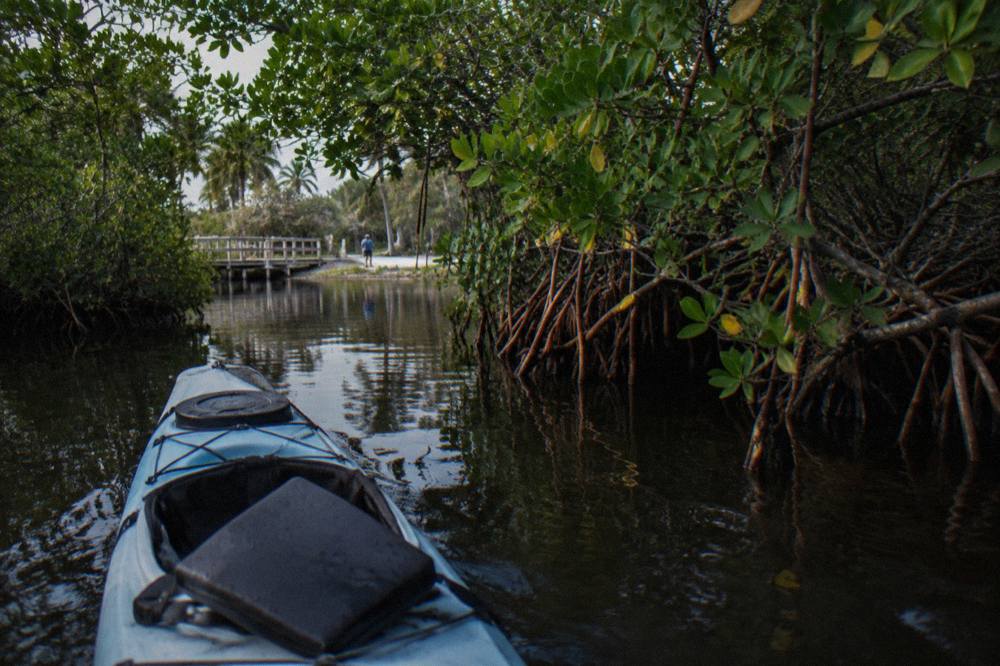
Why The Lagoon Near Cocoa Beach Glows At All
The glow comes from tiny organisms concentrated in the shallow, warm, landlocked waters of the Indian River Lagoon system behind Cocoa Beach and Merritt Island. Dinoflagellates called Pyrodinium bahamense flash blue-green light when disturbed, a defense reaction triggered by paddle strokes, fish movement, or a hand pulled through the water. Density, warmth, and darkness make the lagoon the right stage.
The flashing is mechanical, not mystical. Each dinoflagellate cell contains chemicals that produce light the instant the cell is agitated, which is why the effect tracks movement so precisely: a paddle lifts, a burst of sparks trails off the blade, a mullet darts underneath and draws a glowing line across the water. On a dense night, manatees and dolphins swimming beneath the surface leave visible trails, and several Cocoa Beach operators report exactly that on summer tours.
Why here and not everywhere on Florida's coast comes down to water chemistry and confinement. The lagoon is shallow, poorly flushed, and warm for most of the year, conditions Pyrodinium bahamense thrives in. The same stretch of water supports the seagrass and fish stocks that keep the food web running, and recent monitoring by the St. Johns River Water Management District recorded seagrass coverage in the lagoon growing from 9,924 hectares in 2023 to 17,042 hectares in 2025, a recovery that researchers link to improving conditions for the grazing manatees that share these waters.
That context is why the season can shift a week or two either side of the usual pattern. A warm September extends the dinoflagellate window; an early cold snap kills it early. The organisms are wild and their density varies night to night with water temperature, salinity, and wind, which is also why no honest operator will promise a specific intensity on a specific date. What they can promise is that they launch where the glow is most likely and that they move launches when conditions demand it.
The seasonal pattern holds well enough to plan around, though. The table below is the practical calendar, built from the Space Coast season as operators and local reporting describe it.
| Month | What glows | How strong | Planning note |
|---|---|---|---|
| January | Comb jellies | Good, near jelly peak | Cold nights, dress warm |
| February | Comb jellies | Good | Late-month warmth can start transition |
| March | Transition | Unpredictable | Jellies fading, dinos not yet started |
| April | Quiet | Weak | Off season for glow |
| May | Dinoflagellates begin | Building late month | Season typically opens late May |
| June | Dinoflagellates | Reliable | Good glow, fewer crowds than August |
| July | Dinoflagellates | Peak | Densest blooms, book well ahead |
| August | Dinoflagellates | Peak | Warmest water, brightest sparks |
| September | Dinoflagellates | Reliable, fading late | Strong early, softer by month end |
| October | Dinoflagellates fading, jellies arriving | Variable | Early month still good, then a gamble |
| November | Transition to comb jellies | Unpredictable | Shoulder-season risk |
| December | Comb jellies | Good, building | Cool, calm nights suit jellies |
The Dinoflagellate Season: Late May To Early October
The bright, sparkler-style bioluminescence season on the Space Coast runs roughly late May to early or mid October, with July and August as the undisputed peak months. June and September are dependable but slightly softer, and early October can still deliver before the bloom thins. Outside that window this style of glow is unlikely.
Within the season, the month-to-month texture matters for planning. June is the value pick: blooms are established, water is warm, and tour demand has not yet hit its August ceiling, so you get strong glow with an easier booking picture. July and August are the headline months, when the warmest water pushes Pyrodinium bahamense to its densest concentrations and the water can light up around every paddle stroke, a jellyfish, or a passing fish. That fame has a cost: peak weekends fill first, and the calm, windless nights that produce the best glow are exactly the nights everyone wants.
September deserves more attention than it gets. The glow remains reliable through the first weeks, the summer crowds thin as school restarts, and water temperatures stay high into the month. Late September and the first days of October are the fading edge, capable of a strong showing but no longer dependable, and by mid October the season is effectively over for the year. Anyone booking an October trip should go early in the month and keep expectations calibrated.
The featured pick for this window is the 2-hour Bioluminescence Kayak Tour from Kelly Park East on Merritt Island, from $75 per person, rated 4.8 across 928 reviews, with kayaks, paddles, life jackets, and a professional guide included and free cancellation on the booking. Two other strong options cover the same waters in different formats: a 1.75-hour kayak and paddleboard adventure from Kiwanis Island Park, from $65 per person and rated 4.8 across 216 reviews with a group capped at 12, and a shorter 1.5-hour outing from Brady Yaks Tours and Rentals, from $51.36 per person and rated 4.5 across 167 reviews, the budget entry of the three. You can Check availability on the main listing once your month is set, and the fuller Cocoa Beach bioluminescence tour guide compares all of them side by side.
The Comb Jelly Season: November To March
From roughly November or December through February or March, the lagoon's glow shifts to comb jellies, non-stinging drifters that flash a soft blue-green pulse when disturbed. December and January are typically the strongest months, and the experience is gentler and slower than the summer sparkler, closer to lantern light than fireworks.
Comb jellies reward a different kind of attention. A dinoflagellate night is loud in light: bursts, streaks, and sparks following every movement. A comb jelly night is quiet and cumulative, with soft glows drifting past the hull, each one pulsing as your wake reaches it. Photographers often prefer the summer show, but guests who paddle both frequently describe the jelly nights as the more atmospheric of the two, especially on a still December evening when the water is glassy and the air is cool.
The transition between the two seasons, late October into November and again in March, is the least predictable stretch of the year. Some nights deliver both organisms, a rare double effect that local operators occasionally report around the shoulder of the new moon in early October. Other nights deliver neither. There is no way to know in advance, so the honest advice for shoulder-season travelers is to treat the glow as a possible bonus on a pleasant night paddle rather than the reason for the trip.
A few practical notes carry over regardless of organism. All three glow seasons run at night, so Florida's paddling rules apply in their nighttime form: a Coast Guard-approved life jacket for each person, a sound-producing device such as a whistle, and a white light ready to signal, requirements the FWC spells out for kayaks and paddleboards. Tour operators supply all of it, which is one of the quieter arguments for a guided trip over a solo rental after dark. The detailed season overview on the Cocoa Beach bioluminescence season guide walks through the same calendar with a planning focus.
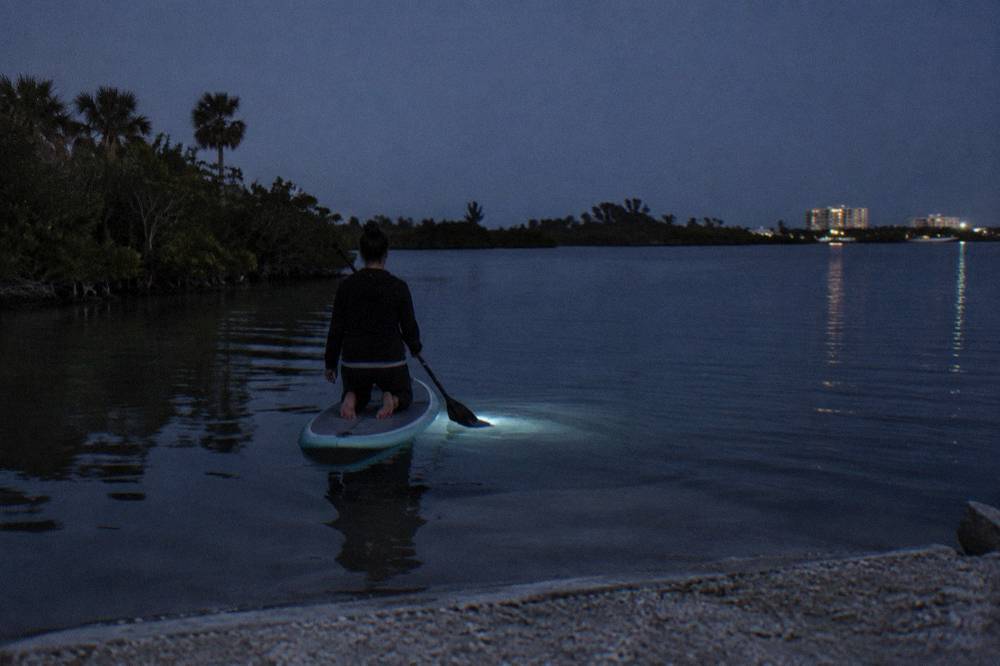
How The Moon Changes Everything
The month sets the organism, but the moon phase sets the visibility: new moon and dark moon windows give the strongest contrast, because faint bioluminescence is overwhelmed by moonlight. A peak July bloom under a full moon can look weaker than a modest September bloom under a dark sky. Booking within a few days of the new moon matters as much as booking the right month.
This is the detail casual planners miss. The glow is real in the second week of the lunar cycle too, but a bright moon washes the water surface with light and your eye loses most of the blue-green flashes against it. Operators schedule their strongest departures in the dark windows, roughly five nights on either side of the new moon, and those departures sell first. If your dates allow any flexibility, pull up a lunar calendar before you pull up a booking page, and anchor the trip to the dark window inside your chosen month.
The moon also explains why two friends can report opposite things about the same week in August. One paddled three nights after the new moon and describes a lagoon on fire; the other paddled near the full moon and wonders what the fuss was about. Same water, same bloom, different sky. When a listing's calendar shows departures clustered at the start of a month and then thinning mid month, that clustering is the dark window at work.
Weather plays the same role in the other direction. Wind chops the surface and scatters the light, and heavy rain in the days before a paddle can freshen or muddy the water depending on where it falls. Thunderstorms are a summer reality in Florida, and the Atlantic hurricane season runs June 1 to November 30; when conditions turn, the operator decides, cancels, or reschedules, and they announce that, not the forecast app on your phone. Booking with free cancellation, which all three Space Coast glow listings here carry, removes most of that risk from your planning.
The safety framework behind these night paddles is straightforward, and the Florida Fish and Wildlife Conservation Commission publishes the gear rules for kayaks and paddleboards, including the night-lighting requirement, on its boating regulations page. The National Park Service covers launch access for the lagoon's northern end on its Canaveral National Seashore paddling page, useful if you are combining a glow tour with a refuge day trip.
Which Month Should You Book?
For the classic bright glow, book July or August, ideally on a dark moon night; for the same organism with thinner crowds, book June or early September. For comb jellies, book December through February. Avoid April and early May, when the lagoon is reliably dark, and treat late October and November as a coin flip between seasons.
The decision usually comes down to what kind of trip you want. Families with school-age children are often locked into summer, which conveniently is peak season, and August dark-moon weeks are the single best combination of organism density and vacation timing. Couples and shoulder-season travelers do well in June or September, when the glow is dependable, the heat is slightly gentler, and the departure calendars are less fought over. Winter visitors, snowbirds, and holiday travelers should lean into comb jellies rather than hoping for a July experience in January, because it will not be there.
Budget differences between the months are minimal; the listings price the same year round, from $51.36 to $75 per person across the three tours compared here. What changes is availability. Anyone unsure whether the experience justifies the price can read the verdict in the glow tour worth-it breakdown, and anyone comparing this against a daytime dolphin trip can start from Dolphin Tours Cocoa Beach and its tour picker.
One last framing that helps: think of the glow as a probability, not a promise. The organisms are wild, their density swings, and even a peak August night under a perfect moon can be softened by a week of wind. What the month table buys you is the best odds, and what a good operator adds is local knowledge of which launch is producing this week. Book the right month, aim for the dark moon, and let the lagoon do the rest.
Common Questions About Bioluminescence Months In Florida
what month is bioluminescence in florida?
July and August are the peak months for the bright dinoflagellate glow on the Space Coast, with June through early October reliable. Comb jellies glow from roughly November or December through February or March, peaking around December and January. April and early May are the quiet months with little glow of either kind.
Can you see bioluminescence in Cocoa Beach in winter?
Yes, but it is a different organism. Winter brings comb jellies, which flash a soft, slow blue-green pulse rather than the bright sparks of summer dinoflagellates. December through February is the reliable comb jelly window, and several Merritt Island operators run night tours through it.
Does the moon phase affect bioluminescence tours?
It affects visibility, not the organisms. Moonlight washes out the faint blue-green glow, so departures within a few nights of the new moon offer the best contrast and fill up first. The same bloom can look spectacular under a dark sky and unremarkable under a full moon.
Is October too late for bioluminescence in Florida?
Early October can still produce a strong dinoflagellate showing, but the season fades through the month and becomes unpredictable as comb jellies arrive. Early October is a reasonable bet; late October and November are a genuine gamble between the two seasons.
Do bioluminescence tours guarantee you will see the glow?
No. The organisms are wild and their density varies with water temperature, salinity, wind, and recent weather. Operators launch where the glow is most likely and shift launch sites when conditions change, but no honest tour guarantees an intensity or a sighting.
What should you wear on a night bioluminescence paddle?
Quick-drying clothes you do not mind getting splash-wet, water shoes, and bug spray applied before arrival, since summer lagoon nights are mosquito country. In the comb jelly months of December through February, add a warm layer; the glow is on the water, but you are sitting still in cool air for two hours.